Made with
ConceptDraw
DIAGRAM 18

Data Flow Diagram

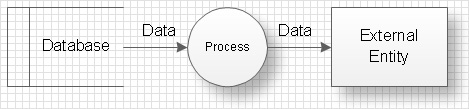
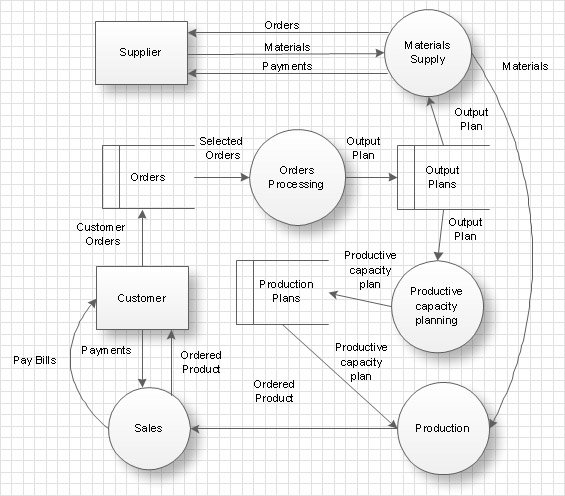
Data Flow Diagram (DFD) is the part of the SSADM method (Structured Systems Analysis and Design Methodology), intended for analysis and information systems projection. Data Flow Diagrams are intended for graphical representation of data flows in the information system and for analysis of data processing during the structural projection. By means of data flow diagrams, it is possible to show visually the work of the information system and the results of this work. Data Flow Diagram visualizes processes, data depositories, and external entities in information systems and data flow connecting these elements.

Data Flow Diagram consists of the following components:

  • Processes and functions which represent actions that happened in the information system;
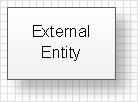
  • External entities which represent in the system data ingoing and outgoing from it;
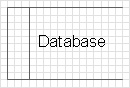
  • Data depositories which represent places in the system where data can be saved for a definite period of time;
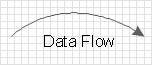
  • Data flows, indicating the direction and character of data flowing in the considered information system.

Diagram element Graphical presentation
Process
External Entity
Data Store
Data Flow

This variant of presentation of Data Flow Diagram objects got the name of Yourdon – de Marco notation.

Objects of Data Flow Diagrams are interpreted in the following way:

  • Processes transform input data flows into output data flows;
  • Data depositories serve only for the keeping of ingoing data and do not change them;
  • Data flows changes in external entities do not considered.

Every diagram object should have a name. Each data flow is denoted with an indication of transferred data and with the possibility of an indication of the format of these data. Data Flow Diagram should not involve more than 10 objects, excluding arrows, representing data flows. In the case of a more complicated system, the totality of several objects (as a rule, processes) is united and represented on the diagram in the form of one object. This complicated compound object is presented in the form of a separate flow diagram. Each component has a number, at this, diagrams illustrating compound objects are numerated starting from the number of an object which they describe. For example components of the diagram of the description of an object with number 5 will be enumerated 5.1, 5.2, etc. Generally, Process Flow Diagram depicts just the major equipment without details.

For clearness, there is a possibility to duplicate notations of used data depositories and external entities. Processes can’t be duplicated. For example, if one the same data depository is used in several different processes it is better to duplicate it on the diagram but not to create several intricate data flow arrows from one object to several processes. This concerns external entities as well. Duplicates of data depositories are marked with the double line from the left side, external entities duplicates - with the asterisk.

Data flow on the diagram can ramify and merge which implies branching or confluence of data in the information system.

Data Flow Diagram *

Example 1. Data Flow Diagram

Thus the information system is represented by a planner in the form of the high-level DFD in which objects are worked out in detail by diagrams of the lower level with the preset level of detailed elaboration. There is also another way of looking at which all events in the system are described at once and each event is represented in the form of process transforming data flows, further these sub runs are grouped for getting diagrams of the higher level.
process flow diagram

Example 2. Data Flow Diagram in ConceptDraw DIAGRAM

The following features make ConceptDraw DIAGRAM extended with Data Flow Diagrams Solution the best Data Flow Diagram software:

  1. You don't need to be an artist to draw professional-looking diagrams in a few minutes.
  2. Large quantity of ready-to-use vector objects makes your drawing diagrams quick and easy.
  3. A great number of predesigned templates and samples give you a good start for your own workflow diagram or process flow diagram.
  4. ConceptDraw DIAGRAM provides you the possibility to use the grid, rules, and guides. You can easily rotate, group, align, arrange the objects, use different fonts and colors to make your organizational workflow diagram exceptionally looking.
  5. All ConceptDraw DIAGRAM documents are vector graphic files and are available for reviewing, modifying, and converting to a variety of formats: image, HTML, PDF file, MS PowerPoint Presentation, Adobe Flash, MS Visio.
  6. Using ConceptDraw STORE you can navigate through ConceptDraw Solution Park, managing downloads and updates. You can access libraries, templates, and samples directly from the ConceptDraw STORE.
  7. If you have any questions, our free of charge support is always ready to come to your aid.


TEN RELATED HOW TO's:
Have you ever needed a flowchart, but did not have the time or tools to build one? Rapid Draw allows you to build a professional flowchart quickly and easily. You have the ability to add your own shapes to Rapid Draw’s built in shape library.How To Create a FlowChart using ConceptDraw *
Picture: How To Create a FlowChart using ConceptDraw
Related Solution:
Garrett IA diagrams are used at development of Internet-resources, in particulars at projecting of interactions of web-resource elements. The diagram of information architecture of the web resource which is constructed correctly with necessary details presents to developers the resource in comprehensible and visual way.Garrett IA Diagrams with ConceptDraw DIAGRAM  *
Picture: Garrett IA Diagrams with ConceptDraw DIAGRAM
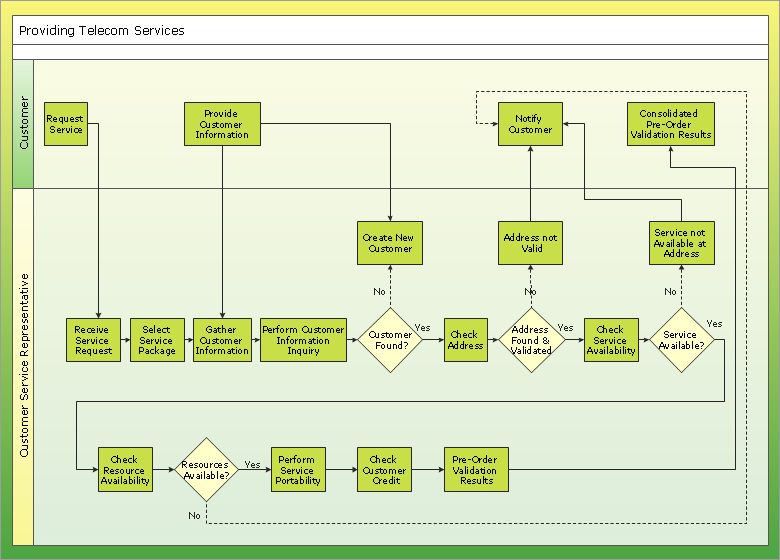
Business Process Flow Diagram is one of the main tool of business analysis and business process re-engineering that lets identify and easy understand process flows within organization. Sign up and start today.Business Process Flow Diagram
Picture: Business Process Flow Diagram
Related Solution:
UML Activity Diagram illustrate the business and operational step-by-step workflow of components in a system and shows the overall flow of control.UML Activity Diagram. Design Elements *
Picture: UML Activity Diagram. Design Elements
A Data Flow Diagram (DFD) is a graphical technique which allows effectively model and analyze the information processes and systems. The ability to fast and easy create the DFDs is made possible with Data Flow Diagrams solution from the Software Development area of ConceptDraw Solution Park. For designing the Data Flow Diagrams are used simple DFD flowchart symbols which are connected each other by arrows depicting the data flow from one step to another.DFD Flowchart Symbols *
Picture: DFD Flowchart Symbols
Related Solution:
Acquaintance with flowcharting starts from getting into basic terms. First of all, flowchart definition is quite clear – a flowchart is a graphical representation of a process or an algorithm made of special symbols. Secondly, flowcharting is an irreplaceable tool for IT specialists, project managers, and anyone who wants a clear understanding of any imaginable process.Flowchart Definition
Picture: Flowchart Definition: A Complete Guide
Related Solution:
Event-Driven Process chain Diagrams for improvement throughout an organisation. Best software for Process Flow Diagram. The Event-driven Process Chain (EPC) Diagrams allows managers to plan processes and resources.Business process Flow Chart — <br>Event-Driven Process chain (EPC) diagrams *
Picture: Business process Flow Chart — Event-Driven Process chain (EPC) diagrams
Related Solution:
UML Interaction Overview Diagram schematically shows a control flow with nodes and a sequence of activities that can contain interaction or sequence diagrams.Interaction Overview Diagram *
Picture: Interaction Overview Diagram
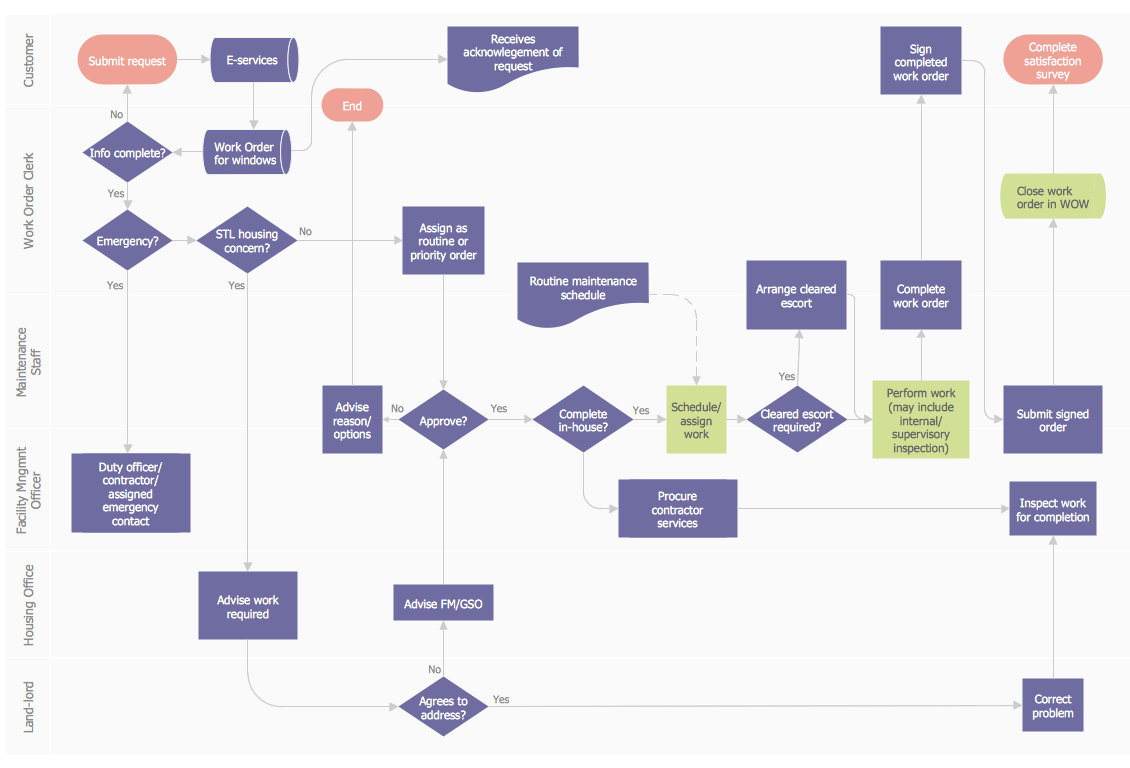
A flowchart is a simple but very functional tool when it comes to understanding a workflow or to removing unnecessary stages from a process. When drawing flowcharts, keep in mind that there are four common types of flowcharts, like document flowcharts and data flowcharts that show control over a data or document flow over a system. To show controls on a physical level, use system flowcharts. In addition, to show controls in a program, you can draw a program flowchart. This flowchart diagram represents the piece of an article editing process, that involves the author and editor. It was created using the Basic Flowchart notation that consists from the basic flowchart symbols. The start and the end of the process are indicated with "Terminator" symbols. The "Process" symbols show the action steps consisting from making edits and searching for a compromise, when the author does not agree with the suggestions of the editor. The "Process" symbol is the general symbol in process flowcharts. The "Decision" symbol indicates a branching in the process flow. There are two branches indicated by a Decision shape in the current flowchart (Yes/No, Disagree/Agree). This basic flowchart can be used as a repeating unit in the workflow diagram describing the working process of some editorial office.Types of Flowcharts *
Picture: Types of Flowcharts
Related Solution:
Any information system receives data flows from external sources. In order to visualize them there is a list of data flow diagram symbols that describes how the system components cooperate. If you want to create a data flow diagram, ConceptDraw DIAGRAM Solution Park has DFD Library that contains both Yourdon and Gane-Sarson notations. This figure shows the content of vector libraries, delivered with ConceptDraw solution for data flow diagram (DFD). There are three libraries composed from about 50 vector objects used to make data flow diagrams. They include a complete set of objects utilized by Yourdon-Coad and Gane-Sarson notations - two primary notations that are apply for data flow diagramming. Also, one can discover additional "Data flow diagram (DFD)" library that provides a data flow diagram elements for designing level 1 and context-level data flow diagrams.Data Flow Diagram Symbols. DFD Library *
Picture: Data Flow Diagram Symbols. DFD Library
Related Solution:
ConceptDraw
DIAGRAM 18