Economic Activities
All human activities are divided into two categories: economic activities and non-economic activities. Non-economic activities are activities not concerned with money or wealth, undertaken for the soul and out of love. In turn, economic activities are the processes based on inputs and leading to the manufacture of goods or the provision of services.
Economic activities are all activities related to producing, distributing, providing, purchasing, exchanging, selling, and consuming goods or services. It is also resource management, the use of resources and capital for producing goods and services. Also making them available to consumers to be utilized for satisfying their needs and unlimited wants. According to the sector, the economic activities are divided into categories like agriculture, industry, construction, etc.
Mostly the economic activities are driven by rationality and logic, and lead to achievement profit. The use of factors of production like land, capital, labour, entrepreneur and income generation is one of the main indicators of economic activities. The income can have different forms like salary, profit, wages, rent, royalty, and more.
Moreover, economic activities are productive and obligatory motivated by certain aspects of the production of goods and services. All activities directed at bringing the products to the market like warehousing, transporting, etc. are also productive economic activities. And even the production for self-consumption is a productive economic activity because it increases the overall supply of the market.
Economic activities exist at all levels within society. All activities we perform to earn money or things of value are economic activities. The process of production of goods and services includes combining different factors like land, labour, capital, entrepreneurship, paid rent, wages, interest, and profits. Consumption as one more economic activity consists of the use of goods and services for the satisfaction of individual or collective wants. It entails the increase of production and supply of goods and services. It also promotes competition and introduction of better products in the market. Another part of produced goods is used for capital formation. And finally, there are no economic activities without savings and investment.
Example 1. Economic Activities
There are five basic types of economic activities:
- Primary sector works with raw materials. It includes physical resources coaxed or extracted from the earth, and raw materials mined, harvested, fished, or collected. The raw materials are only obtained and later are sold to businesses in other economic sectors.
- Secondary sector includes industry and manufacturing, and transforms raw materials from the primary sector into value-added products. The manufactured products have higher value and worth than used materials due to the application of labour, intelligence, equipment, systems.
- Tertiary sector trades in information and services. For most population, it is the main sector to earn for living.
- Quaternary sector is knowledge or intellectual sector. It is built on intellectual activity and the flow of information. It includes scientific researchers, professors, internet technicians, etc.
- Fifth sector is focused on infrastructure like governments, hospitals, and non-profit agencies.
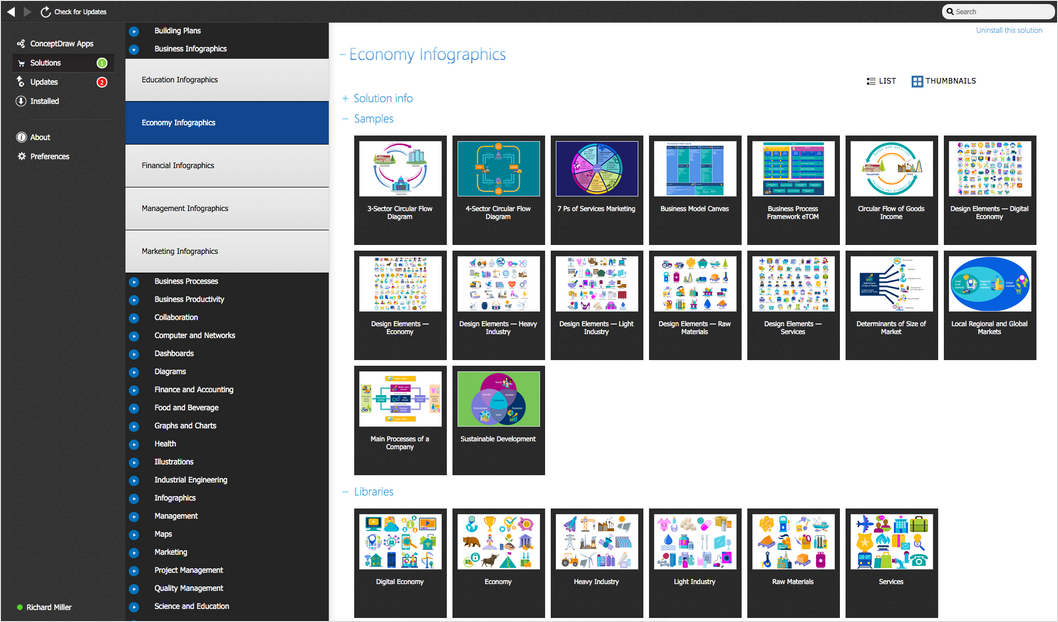
Example 2. Economy Infographics Solution in ConceptDraw STORE
The clear and precise economy infographics are easy-to-understand and especially valuable for people. Designing exceptional and precise economy infographics is incredibly easy with ConceptDraw DIAGRAM software and Economy Infographics solution.
You can start with a blank screen or one of the pre-made samples as a template. Drag and drop specialized vector design elements — economy, industries, services, and more from the solution libraries. Add textual materials about economic activities or some other on your own. Use special tools to align your objects and apply formatting tools to make your infographic looking the best.
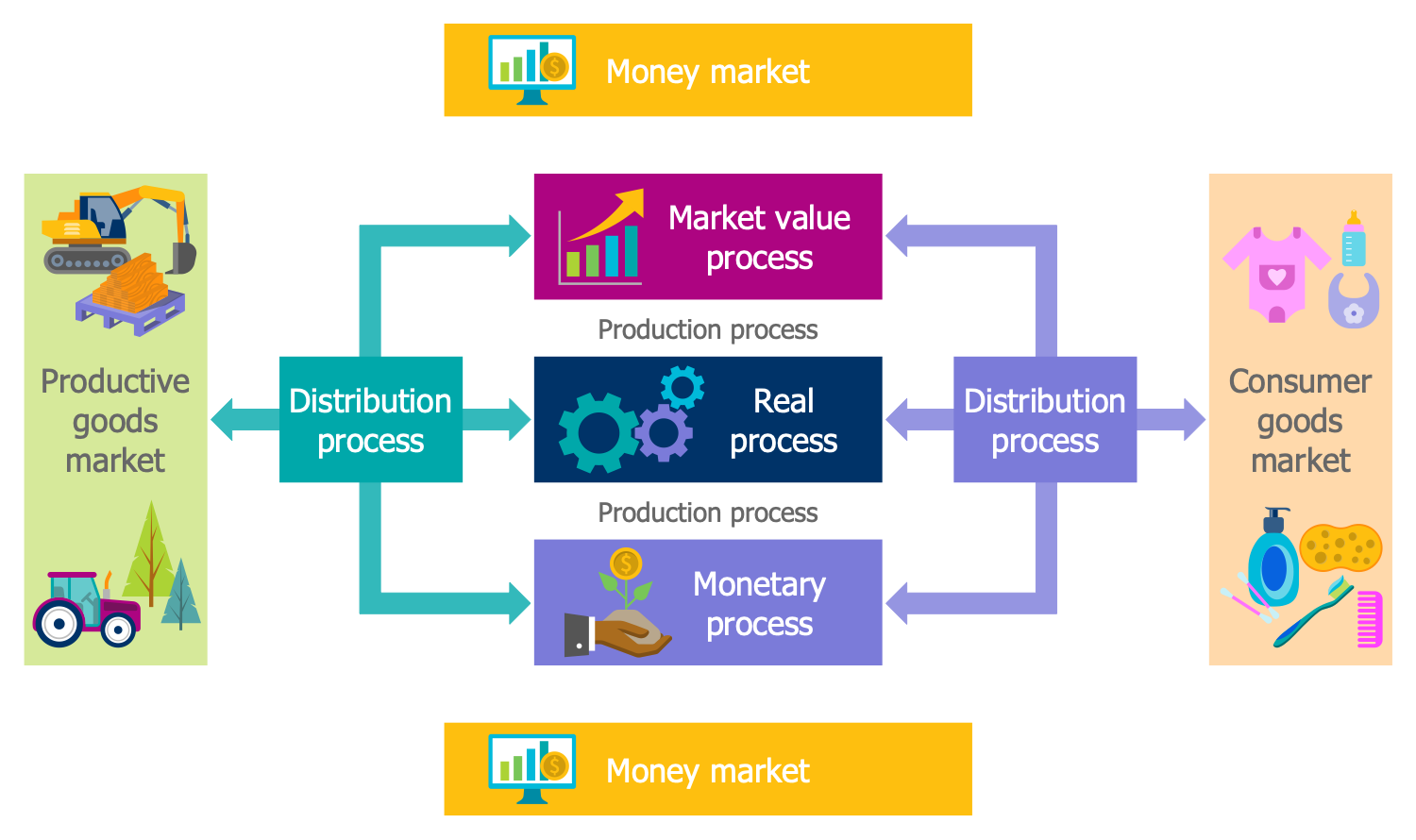
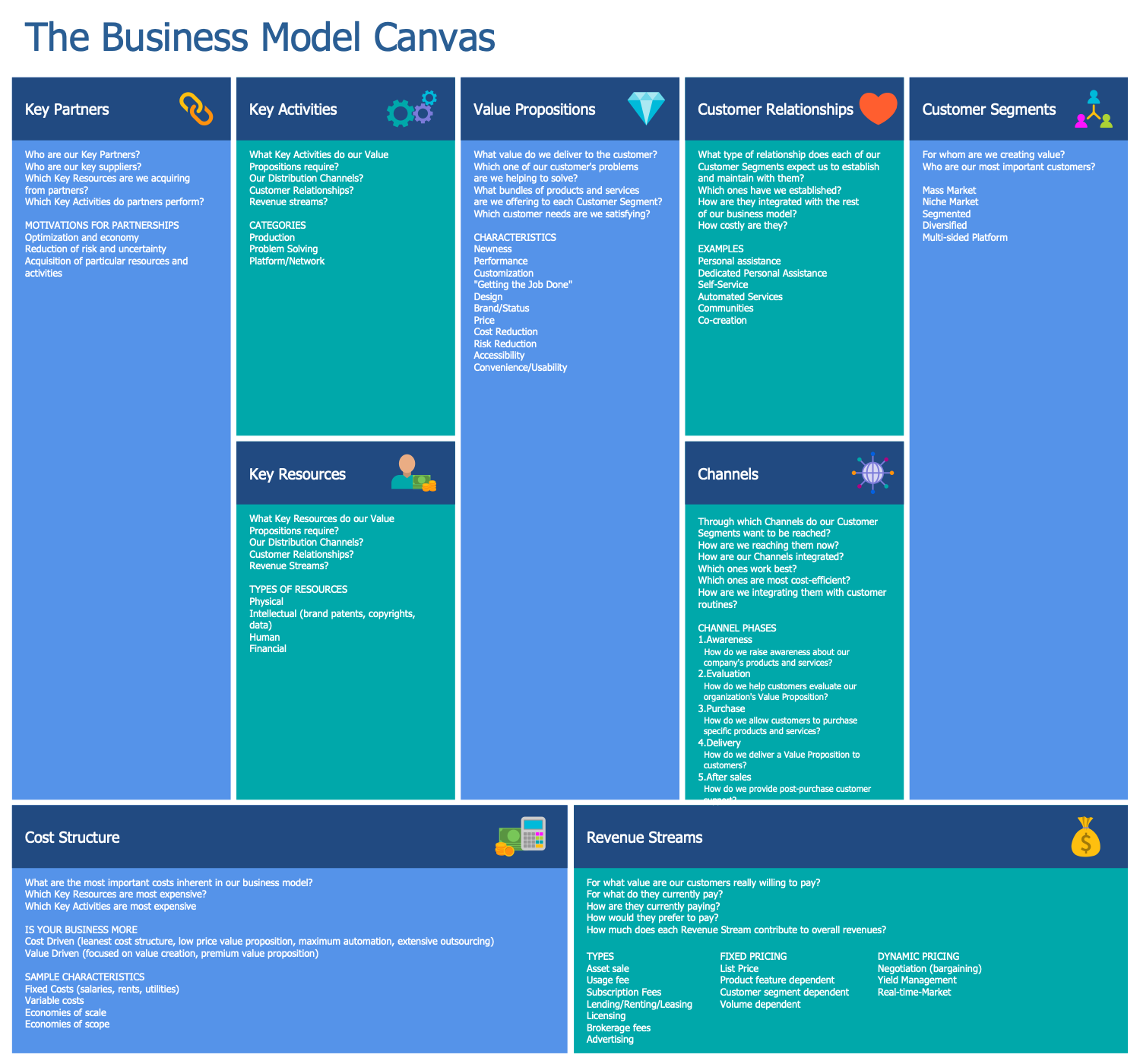
Example 3. Main Processes of a Company
The infographics you see on this page were created in ConceptDraw DIAGRAM software using the Economy Infographics Solution and its pre-made pictograms and clipart. They successfully demonstrate the solution's capabilities and professional results you can achieve. An experienced user spent 10-15 minutes creating each of these samples.
Use the powerful tools of the Economy Infographics Solution for ConceptDraw DIAGRAM software to create your own infographics and diagrams of any complexity fast and easy, and then successfully use them in your work and personal activity.
All source documents are vector graphic documents. They are available for reviewing, modifying, or converting to a variety of formats (PDF file, MS PowerPoint, MS Visio, and many more graphic formats) from the ConceptDraw STORE. The Economy Infographics Solution is available for all ConceptDraw DIAGRAM users.
TEN RELATED HOW TO's:
Accounting is a cornerstone of any business, it’s basement. If you want to have a visual representation of your finance management, use audit flowchart symbols to document the money flow. Although some would say that accounting is boring, it is very a responsible duty.
The audit flowchart symbols is supplied with ConceptDraw Audit Flowcharts solution as a vector objects library. Together with Conceptdraw Drawing capabilities it forms the helpful tool for audit process planning and setting the steps of audit by designing audit flow charts. Audit Flow charts are used to organize fiscal information tracking process as well as in accounting, finance and investment management.
Picture: Audit Flowchart Symbols
Related Solution:
Data structure diagram (DSD) is intended for description of conceptual models of data (concepts and connections between them) in the graphic format for more obviousness. Data structure diagram includes entities description, connections between them and obligatory conditions and requirements which connect them. Create Data structure diagram with ConceptDraw DIAGRAM.
Picture: Data structure diagram with ConceptDraw DIAGRAM
Diagramming is an astonishing way to visualize business processes. The list of the most common business process flowchart symbols is quite long starting from basic flowcharts, continuing with SIPOC diagrams. Business process modeling was never easier than now, with special ConceptDraw Business Process Mapping solution.
To carry out all professional standard requirements for business processes mapping, it is necessarily to follow the special graphical notations. ConceptDraw Business Process Mapping solution offers an exhaustive suite of tools to aid business process mapping. There are three vector libraries SIPOC Diagrams, Business Process Flowcharts, and Swim Lanes that contains totally more than 50 symbols of standard BPM notations. This is all that professionals need to effectively evaluate and manage quality in business processes.
Picture: Business Process Flowchart Symbols
Related Solution:
If you need to describe some process, diagramming is a perfect tool for almost any imaginable purpose. The set of the most commonly used flow charts symbols is quite wide and includes symbols for operations, processes, data inputs and outputs. You can see the full list of all the symbols used for flowcharting in Flowcharts solution from Diagrams area in ConceptDraw Solution Park.
A flow chart is often used for visual representation of a sequential process flow. The flowchart approach to any process is to divide it into some sequential actions. What makes a flow chart so popular and clear to make out is the set of standard flowchart symbols that has the same reading independently from processes described with their applying. The current drawing represents the vector library containing the pack of standard flowchart symbols. This library is supplied with ConceptDraw Flowcharts solution.
Picture: Flow Chart Symbols
Related Solution:
A flowchart is a simple but very functional tool when it comes to understanding a workflow or to removing unnecessary stages from a process. When drawing flowcharts, keep in mind that there are four common types of flowcharts, like document flowcharts and data flowcharts that show control over a data or document flow over a system. To show controls on a physical level, use system flowcharts. In addition, to show controls in a program, you can draw a program flowchart.
This flowchart diagram represents the piece of an article editing process, that involves the author and editor. It was created using the Basic Flowchart notation that consists from the basic flowchart symbols. The start and the end of the process are indicated with "Terminator" symbols. The "Process" symbols show the action steps consisting from making edits and searching for a compromise, when the author does not agree with the suggestions of the editor. The "Process" symbol is the general symbol in process flowcharts. The "Decision" symbol indicates a branching in the process flow. There are two branches indicated by a Decision shape in the current flowchart (Yes/No, Disagree/Agree). This basic flowchart can be used as a repeating unit in the workflow diagram describing the working process of some editorial office.
Picture: Types of Flowcharts
Related Solution:
Use ConceptDraw DIAGRAM diagramming and business graphics software to draw your own flowcharts of computer algorithms.
Picture: Process Flow app for macOS
Related Solution:
The ConceptDraw Flowchart component includes a set of samples and templates. This geathered as flowchart maker toolbox which focused on drawing flowcharts of any industry standards.
Picture: Flowchart Components
Related Solution:
Data flow diagrams are the graphical tool, used in the visualization of data flow of some data processing systems. It is the valuable process modeling tool. Also designing DFD is the important component of the initial part of any information system development project. The standard symbols are used to represent the interaction of a system components and how various kinds of components influence on data flow. The ConceptDraw Data Flow Diagrams solution is design to assist professional software engineers in making DFDs according to Gane and Sarson, and Yourdon and Coad notations.
Do you imagine yourself as a successful IT specialist? To your mind, they all use data flow diagram examples to learn and to get inspired. Aren’t you still with us?
Picture: Data Flow Diagram Examples
Related Solution:
ConceptDraw DIAGRAM is a world-class diagramming platform that lets you display, communicate, and present dynamically. It′s powerful enough to draw everything from basic flowcharts to complex engineering schematics.
Video tutorials on ConceptDraw products. Try it today!
Picture: Business Process Mapping — How to Map a Work Process
Related Solutions:
Event-Driven Process Chain Diagrams for improvement throughout an organisation.
ConceptDraw DIAGRAM - software that reduces the time needed to create a business process model.
Picture: Graphical Symbols to use in EPC diagrams
Related Solution: