Porter's Value Chain
Porter's Value Chain is what can be created with help of ConceptDraw DIAGRAM diagramming and drawing application and having the Matrices solution it can be done much sooner as well as simpler.
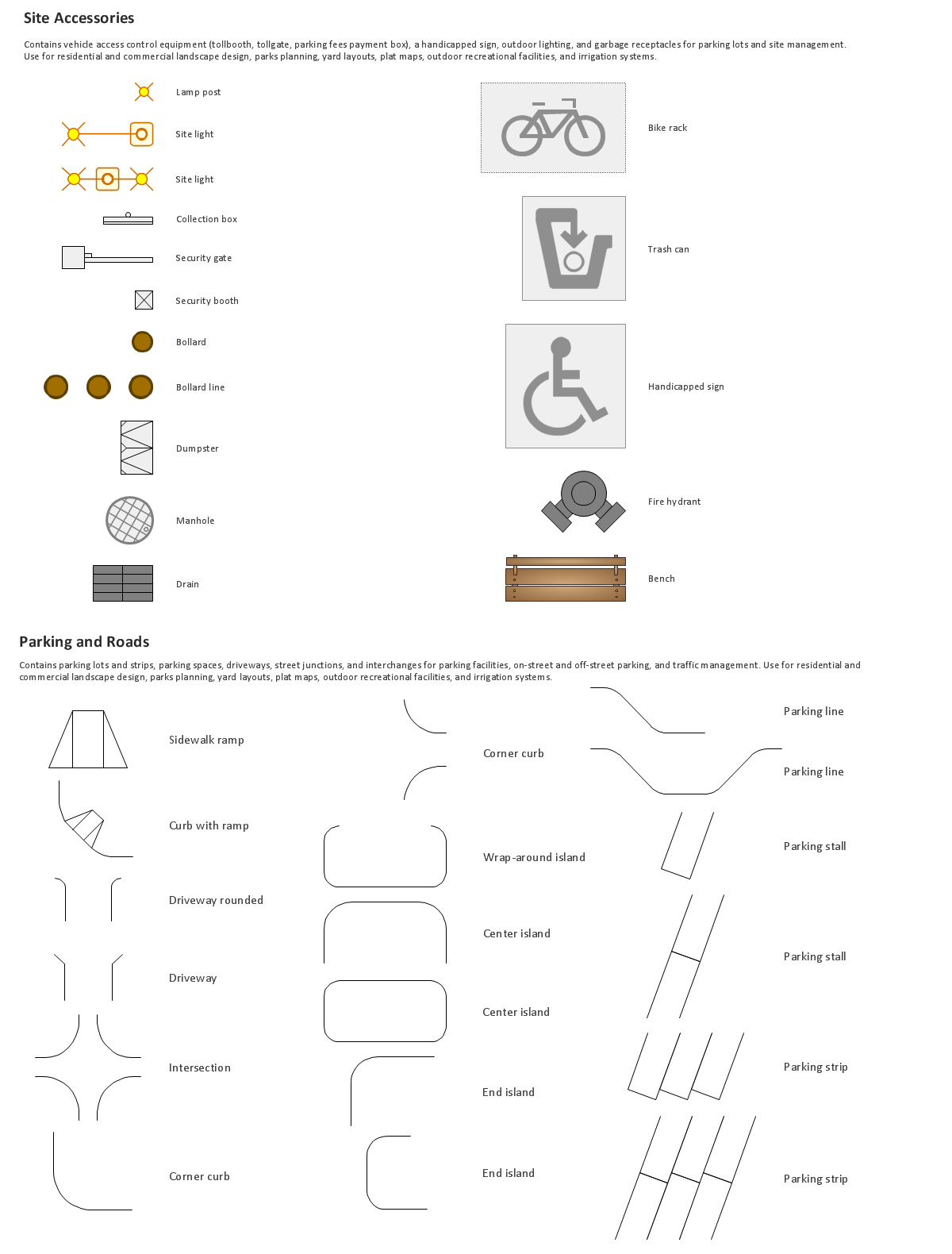
Having the mentioned solution means having an opportunity to use any or all of 10 vector shapes that are available for all the ConceptDraw DIAGRAM users and can be found in the stencil library there.
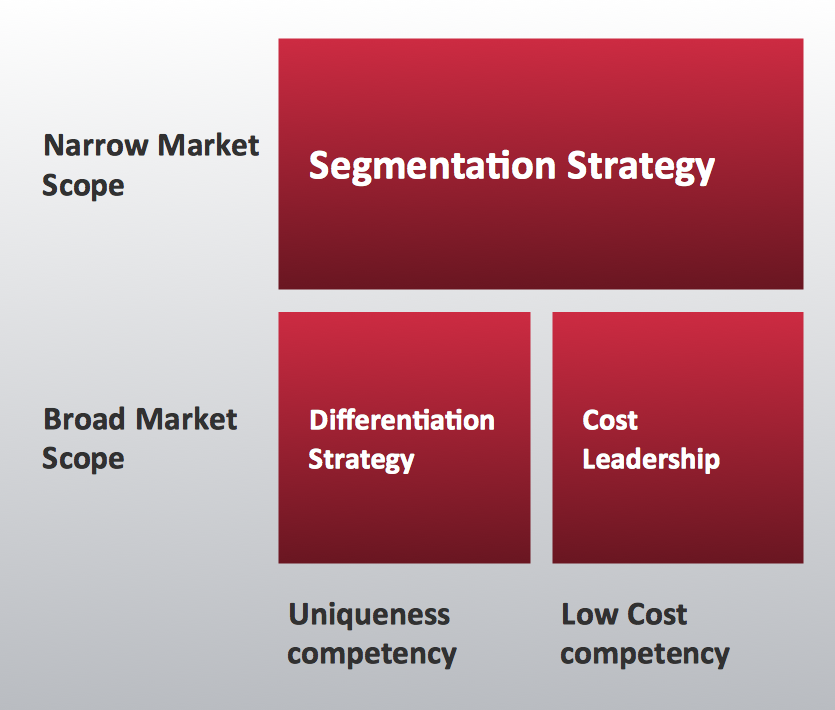
The available pre-made examples of the matrices, including the Porter's Value Chain’s one can be found in the mentioned solution. It also allows creating an Ansoff matrix, a BCG matrix, a Competitive strategies matrix, a Four-quadrant matrix, a Chore chart, a Flow process chart, a Quality function deployment matrix, a Positioning map and Porter’s generic strategies matrix being based on the templates given within the Matrices solution.
Having the already previously created drawings it is much simpler to make any other ones having the existing as drafts that can be always edited the way they have to be edited.
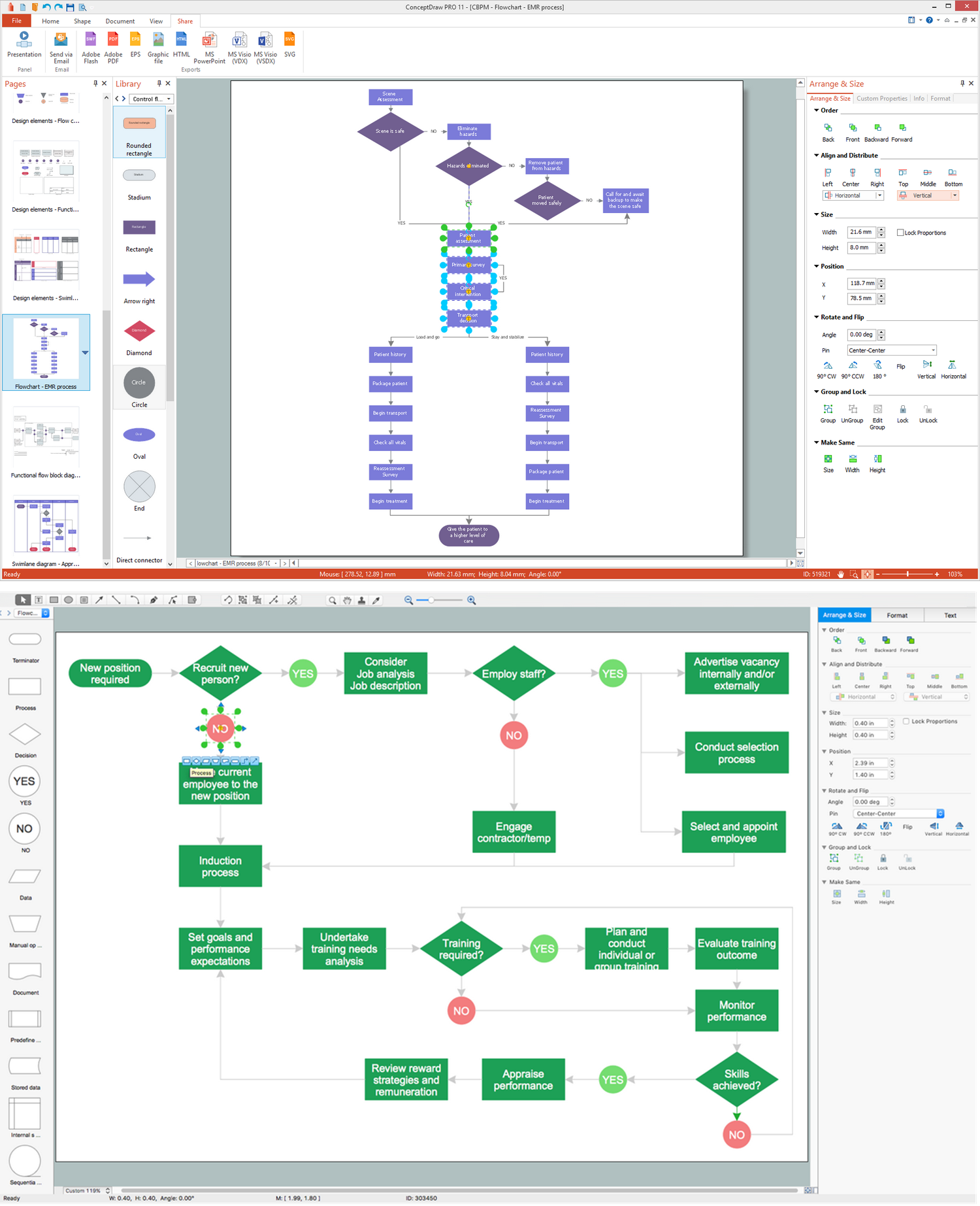
To make a Porter’s value chain matrix to show a set of activities that a company is operating in a specific industry is possible by downloading the ConceptDraw DIAGRAM solution as well as the ConceptDraw STORE one in order to open the Matrices solution to get all the needed stencils and so to create a great looking as well as a professionally looking drawing.
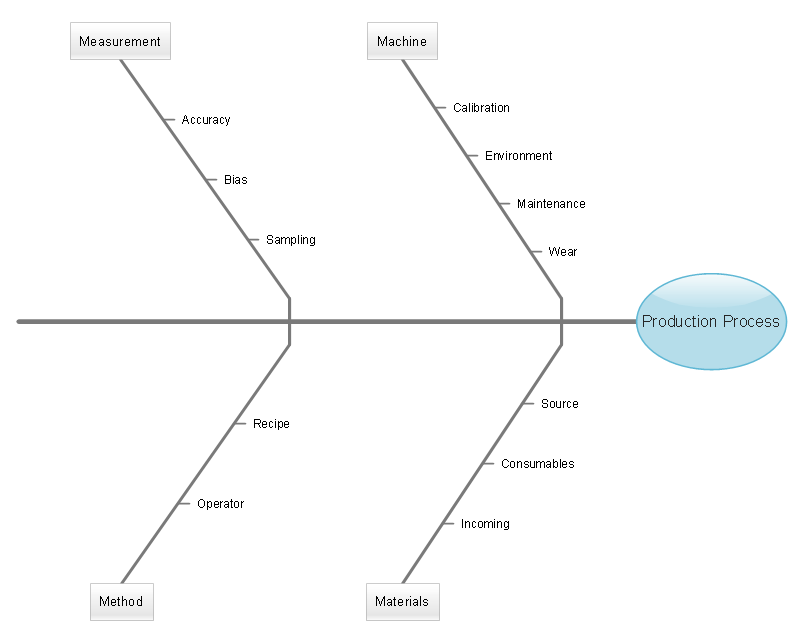
Example 1. Porter's Value Chain Solution
The company may perform the needed activities in order to deliver a valuable product or service for its market and this particular concept comes through business management being first described by Michael Porter in his book named “Competitive Advantage: Creating and Sustaining Superior Performance”.
The main idea of the value chain is known to be based on the process view of organizations. This idea includes seeing some service or manufacturing organization as one system that is made up of the different subsystems each of which has some inputs, outputs and transformation processes.
The mentioned transformation processes, inputs and outputs involve the consumption and acquisition of resources — labor, money, materials, management, buildings, land, equipment and administration. The way value chain activities are carried out can determine both affects and costs profits.
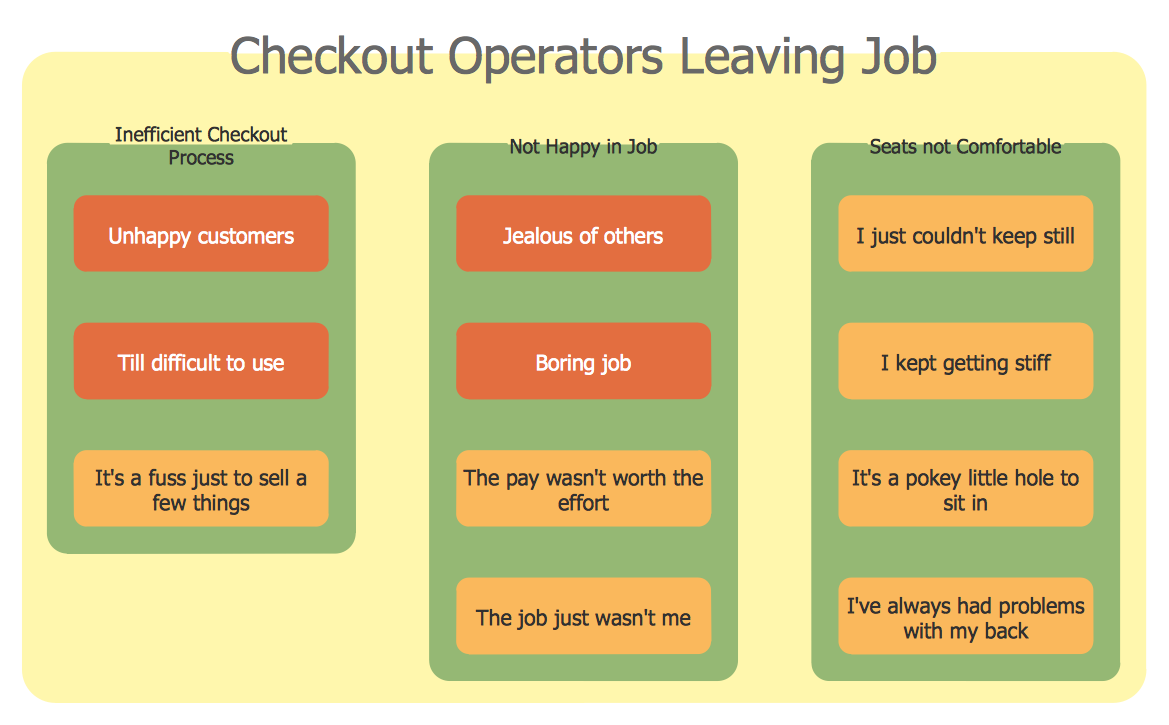
Example 2. Porter's Value Chain
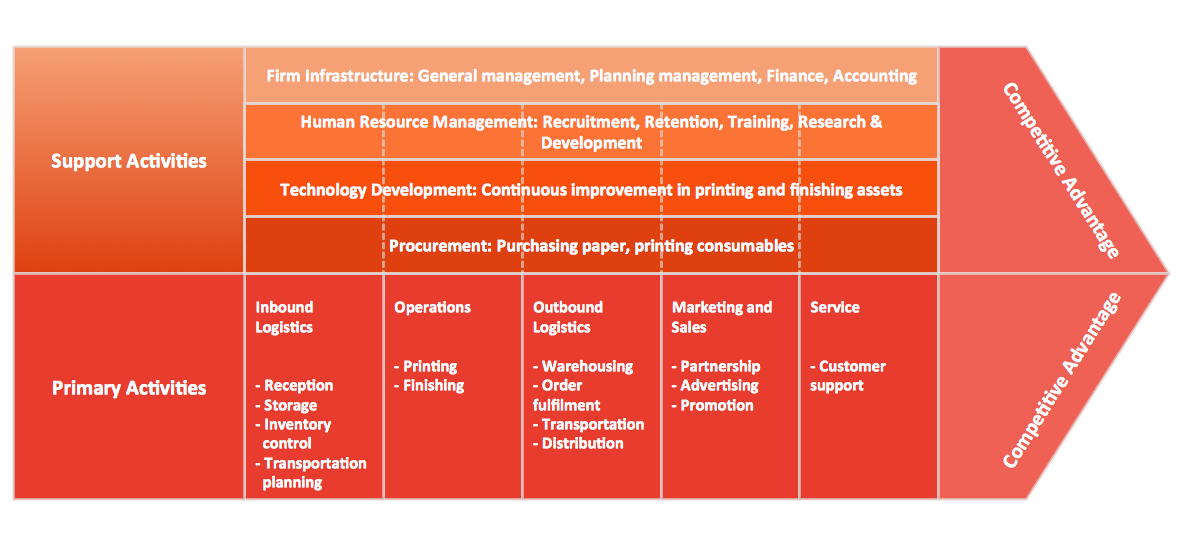
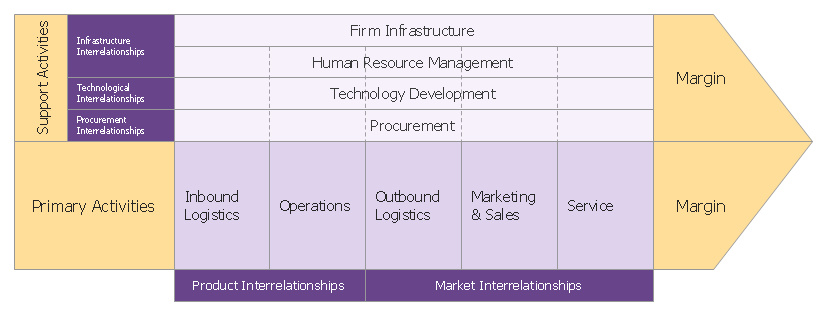
In Porter's value chains, all the operations, the inbound logistics, the services, the outbound logistics as well as the marketing and sales are categorized as the main activities. At the same time, all the secondary activities are known to be including the human resource management, the technological development, the infrastructure and the procurement.
The appropriate level for constructing any value chain is known to be the business unit, but not a corporate level or division. Passing through a chain of activities in order, at each activity each of the products gains some particular value. The chain of activities is known to be giving the products more value to compare to the sum of all the added values of all the activities.
The activity of a diamond cutter, for example, can illustrate the difference between the value chain and the cost. The cutting activity may have a low cost. Although, any activity is known to be adding much of the value to the end product. A rough diamond is known to be significantly less valuable than a cut one, but both of them are widely used.
Example 3. Porter's Value Chain Diagram Template
Usually, the previously described value chain as well as the documentation of the processes, auditing and assessment of adherence to the process routines are known to be the main feature in any quality certification of any business.
A company's value chain is known to be forming a part of a larger stream of activities. Such larger stream of activities is known to be named by Porter as a “value system”. Such value system can also be called as an industry value chain that includes all the suppliers that provide the needed inputs to the firm as well as their value chains.
After some firm creates the new products, the mentioned products go through the value chains of distributors all the way to the customers. All parts of the described chains are known to be included in the value system. In order to sustain and achieve some competitive advantage and so to support that advantage with information technologies, any company is expected to understand every single component of the mentioned value system.
The main activities within the previously described system are operations, inbound logistics, outbound logistics, service as well as marketing and sales. Operations as the processes are concerned with managing the process that converts the inputs into outputs (in the form of some services or/and goods).
Inbound Logistics imply arranging some particular inbound movement of materials, finished inventory and parts from suppliers in order to assemble the plants, the retail stores or warehouses, or to manufacture. At the same time, an outbound Logistics is known to be the process that is related to the movement and storage of the final product having the related information flowing from the end of the production line all the way to the end user.
Example 4. Porter Generic Strategies Matrix
Service includes all the activities that are required in order to keep some service and product working effectively for the buyer both after it is sold and when it is delivered. Marketing and Sales activities are focused on selling the products or services including such processes as communicating, creating, exchanging and delivering the offerings that have some value for clients, customers, society and partners.
Support activities involve infrastructure, development (including the technological one), human resources management and procurement which is the acquisition of some goods, works or services from some outside external source.