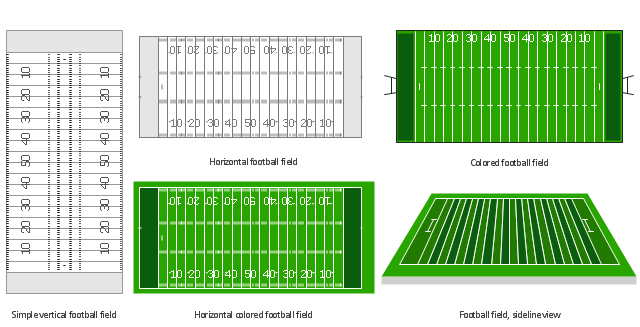
The vector stencils library "Football fields" contains 5 shapes of American football fields for drawing sport diagrams.
"Football field or football pitch may refer to the playing areas of several codes of football:
(1) Association football pitch, a rectangular field, usually 105 m x 68 m or 7140 m².
(2) American football field, a rectangular field, 120.0 yd x 53.3 yd or 6400 yd².
(3) Australian rules football playing field, a large oval-shaped field, usually 150 m long goal to goal and 135 m wide wing to wing.
(4) Canadian football field, a rectangular field, 150 yd x 65 yd or 9750 yd².
(5) Gaelic football playing field, a rectangular field, 130–145 m long and 80–90 m wide.
(6) Rugby league playing field, a rectangular field, 112–122 m long and 68 m wide." [Football field. Wikipedia]
The shapes example "Design elements - Football fields" was created using the ConceptDraw PRO diagramming and vector drawing software extended with the Football solution from the Sport area of ConceptDraw Solution Park.
"Football field or football pitch may refer to the playing areas of several codes of football:
(1) Association football pitch, a rectangular field, usually 105 m x 68 m or 7140 m².
(2) American football field, a rectangular field, 120.0 yd x 53.3 yd or 6400 yd².
(3) Australian rules football playing field, a large oval-shaped field, usually 150 m long goal to goal and 135 m wide wing to wing.
(4) Canadian football field, a rectangular field, 150 yd x 65 yd or 9750 yd².
(5) Gaelic football playing field, a rectangular field, 130–145 m long and 80–90 m wide.
(6) Rugby league playing field, a rectangular field, 112–122 m long and 68 m wide." [Football field. Wikipedia]
The shapes example "Design elements - Football fields" was created using the ConceptDraw PRO diagramming and vector drawing software extended with the Football solution from the Sport area of ConceptDraw Solution Park.
American football field shapes
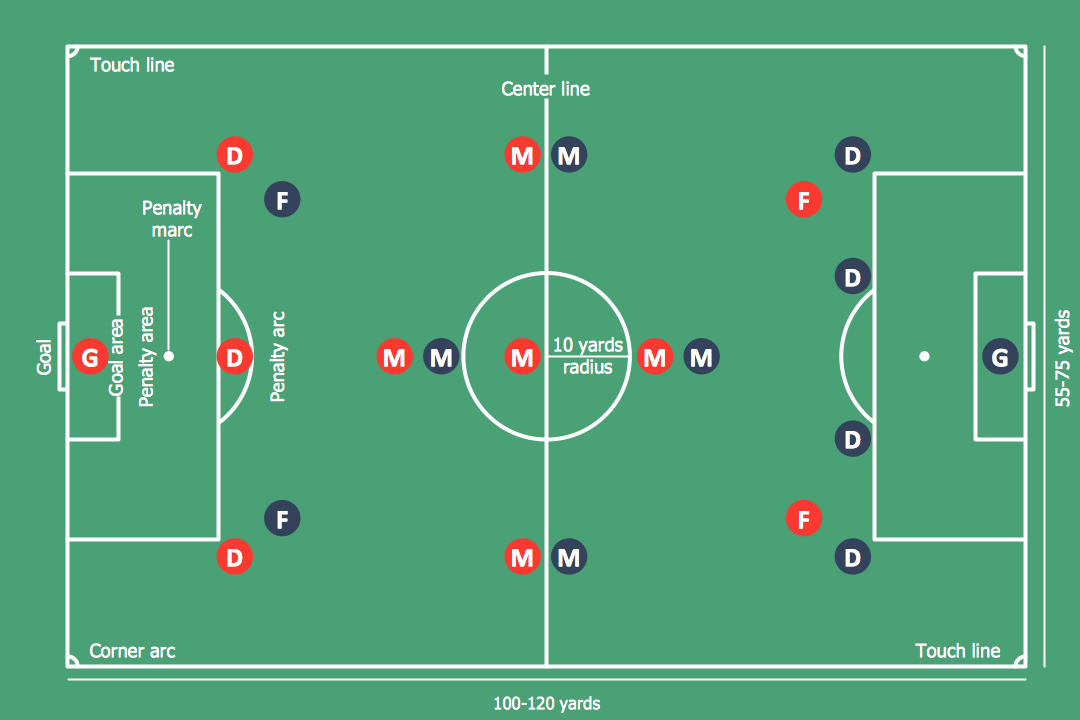
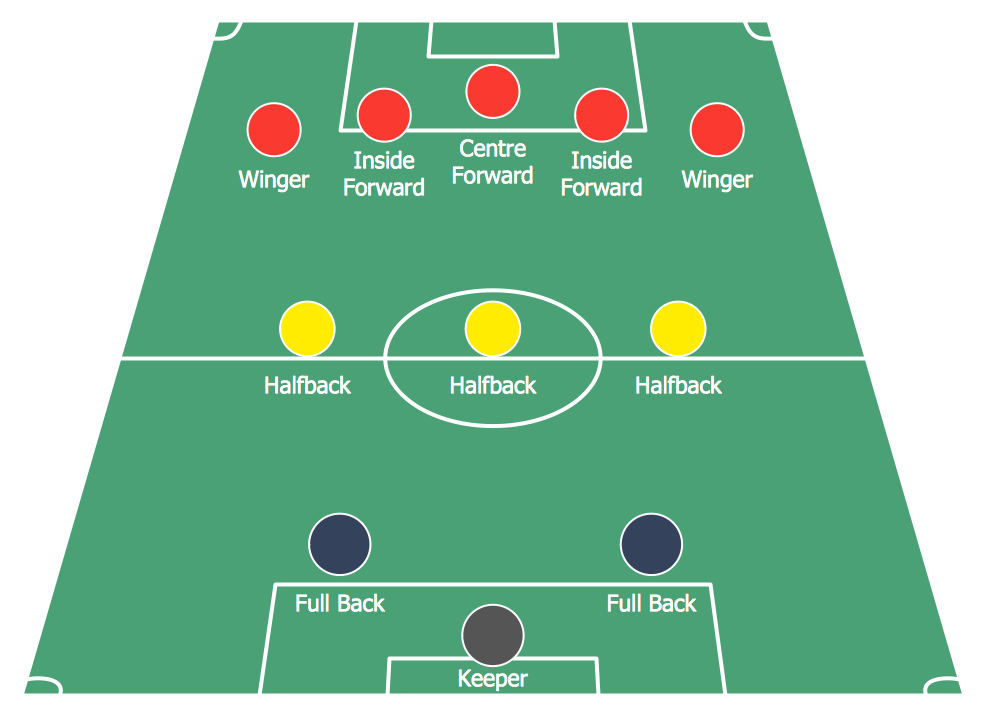
Soccer (Football) Positions
"In association football, the formation describes how the players in a team are positioned on the pitch. Different formations can be used depending on whether a team wishes to play more attacking or defensive football. ...
The WM system was created in the mid-1920s by Herbert Chapman of Arsenal to counter a change in the offside law in 1925. The change had reduced the number of opposition players that attackers needed between themselves and the goal-line from three to two. This led to the introduction of a centre-back to stop the opposing centre-forward, and tried to balance defensive and offensive playing. The formation became so successful that by the late-1930s most English clubs had adopted the WM. Retrospectively, the WM has either been described as a 3–2–5 or as a 3–4–3, or more precisely a 3–2–2–3 reflecting the letters which symbolised it. The gap in the centre of the formation between the two wing halves and the two inside forwards allowed Arsenal to counter-attack effectively. The W-M was subsequently adapted by several English sides, but none could apply it in quite the same way Chapman had. This was mainly due to the comparative rarity of Alex James in the English game. He was one of the earliest playmakers in the history of the game, and the hub around which Chapman's Arsenal revolved." [Formation (association football). Wikipedia]
The diagram example "Association football (soccer) formation 3-2-5 (WM)" was created using the ConceptDraw PRO diagramming and vector drawing software extended with the Football solution from the Sport area of ConceptDraw Solution Park.
www.conceptdraw.com/ solution-park/ sport-soccer
The WM system was created in the mid-1920s by Herbert Chapman of Arsenal to counter a change in the offside law in 1925. The change had reduced the number of opposition players that attackers needed between themselves and the goal-line from three to two. This led to the introduction of a centre-back to stop the opposing centre-forward, and tried to balance defensive and offensive playing. The formation became so successful that by the late-1930s most English clubs had adopted the WM. Retrospectively, the WM has either been described as a 3–2–5 or as a 3–4–3, or more precisely a 3–2–2–3 reflecting the letters which symbolised it. The gap in the centre of the formation between the two wing halves and the two inside forwards allowed Arsenal to counter-attack effectively. The W-M was subsequently adapted by several English sides, but none could apply it in quite the same way Chapman had. This was mainly due to the comparative rarity of Alex James in the English game. He was one of the earliest playmakers in the history of the game, and the hub around which Chapman's Arsenal revolved." [Formation (association football). Wikipedia]
The diagram example "Association football (soccer) formation 3-2-5 (WM)" was created using the ConceptDraw PRO diagramming and vector drawing software extended with the Football solution from the Sport area of ConceptDraw Solution Park.
www.conceptdraw.com/ solution-park/ sport-soccer
Association football (soccer) formation diagram
-formation-diagram-association-football-(soccer)-formation-3-2-5-(wm).png--diagram-flowchart-example.png)
"In association football, the formation describes how the players in a team are positioned on the pitch. Different formations can be used depending on whether a team wishes to play more attacking or defensive football. ...
The 4–3–3 was a development of the 4–2–4, and was played by the Brazilian national team in the 1962 World Cup. The extra player in midfield allows a stronger defence, and the midfield could be staggered for different effects. The three midfielders normally play closely together to protect the defence, and move laterally across the field as a coordinated unit. The three forwards split across the field to spread the attack, and may be expected to mark the opposition full-backs as opposed to doubling back to assist their own full-backs, as do the wide midfielders in a 4–4–2. When used from the start of a game, this formation is widely regarded as encouraging expansive play, and should not be confused with the practice of modifying a 4–4–2 by bringing on an extra forward to replace a midfield player when behind in the latter stages of a game. This formation is suited for a short passing game and useful for ball retention.
A staggered 4–3–3 involving a defensive midfielder (usually numbered four or six) and two attacking midfielders (numbered eight and ten) was commonplace in Italy, Argentina, and Uruguay during the 1960s and 1970s. The Italian variety of 4–3–3 was simply a modification of WM, by converting one of the two wing-halves to a libero (sweeper), whereas the Argentine and Uruguayan formations were derived from 2–3–5 and retained the notional attacking centre-half. The national team which made this famous was the Dutch team of the 1974 and 1978 World Cups, even though the team won neither." [Formation (association football). Wikipedia]
The diagram example "Association football (soccer) formation 4-3-3" was created using the ConceptDraw PRO diagramming and vector drawing software extended with the Football solution from the Sport area of ConceptDraw Solution Park.
www.conceptdraw.com/ solution-park/ sport-soccer
The 4–3–3 was a development of the 4–2–4, and was played by the Brazilian national team in the 1962 World Cup. The extra player in midfield allows a stronger defence, and the midfield could be staggered for different effects. The three midfielders normally play closely together to protect the defence, and move laterally across the field as a coordinated unit. The three forwards split across the field to spread the attack, and may be expected to mark the opposition full-backs as opposed to doubling back to assist their own full-backs, as do the wide midfielders in a 4–4–2. When used from the start of a game, this formation is widely regarded as encouraging expansive play, and should not be confused with the practice of modifying a 4–4–2 by bringing on an extra forward to replace a midfield player when behind in the latter stages of a game. This formation is suited for a short passing game and useful for ball retention.
A staggered 4–3–3 involving a defensive midfielder (usually numbered four or six) and two attacking midfielders (numbered eight and ten) was commonplace in Italy, Argentina, and Uruguay during the 1960s and 1970s. The Italian variety of 4–3–3 was simply a modification of WM, by converting one of the two wing-halves to a libero (sweeper), whereas the Argentine and Uruguayan formations were derived from 2–3–5 and retained the notional attacking centre-half. The national team which made this famous was the Dutch team of the 1974 and 1978 World Cups, even though the team won neither." [Formation (association football). Wikipedia]
The diagram example "Association football (soccer) formation 4-3-3" was created using the ConceptDraw PRO diagramming and vector drawing software extended with the Football solution from the Sport area of ConceptDraw Solution Park.
www.conceptdraw.com/ solution-park/ sport-soccer
Association football (soccer) formation diagram
-formation-diagram-association-football-(soccer)-formation-4-3-3.png--diagram-flowchart-example.png)
 Football

The Football Solution extends ConceptDraw DIAGRAM software with samples, templates, and libraries of vector objects for drawing football (American) diagrams, plays schemas, and illustrations. It can be used to make professional looking documen
Soccer (Football) Dimensions
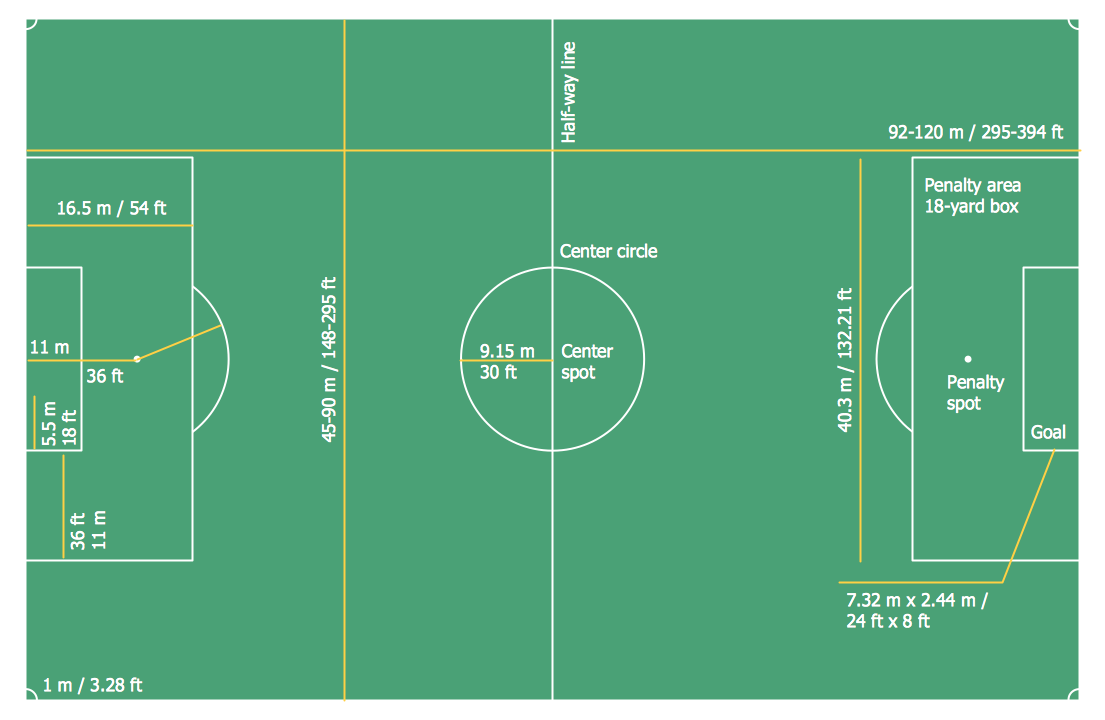
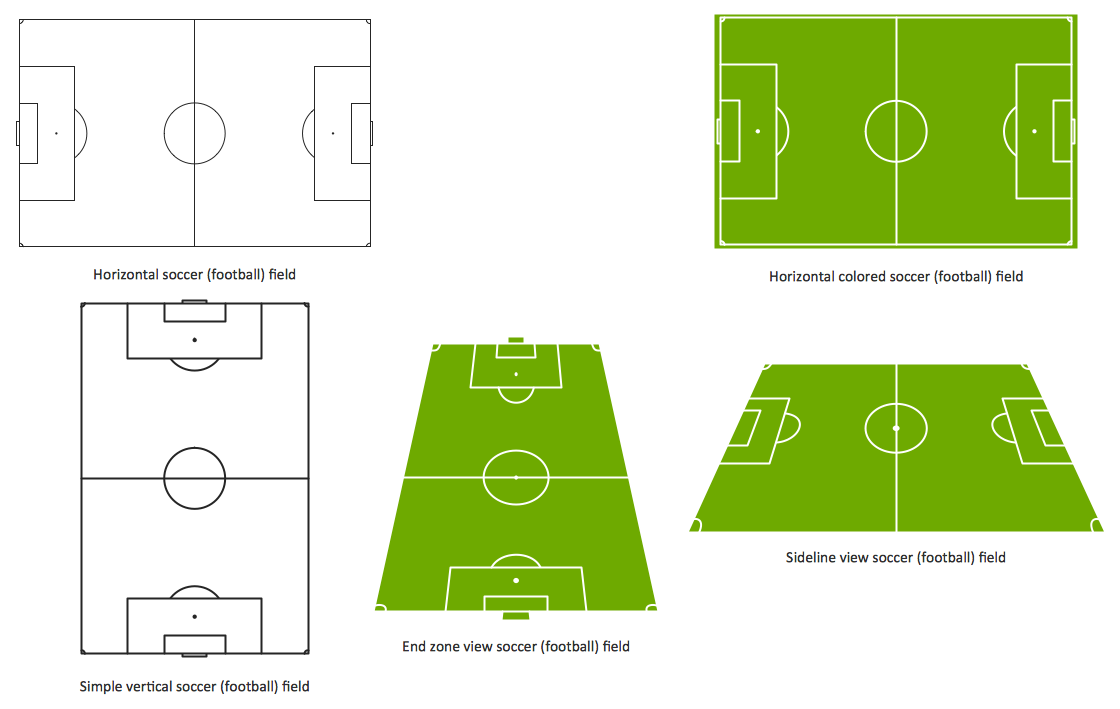
Design a Soccer (Football) Field
"In association football, the formation describes how the players in a team are positioned on the pitch. Different formations can be used depending on whether a team wishes to play more attacking or defensive football. ...
The 3–3–4 formation was similar to the WW, with the notable exception of having an inside-forward (as opposed to centre-forward) deployed as a midfield schemer alongside the two wing-halves. This formation would be commonplace during the 1950s and early 1960s. One of the best exponents of the system was the Tottenham Hotspur double-winning side of 1961, which deployed a midfield of Danny Blanchflower, John White and Dave Mackay. FC Porto won the 2005–06 Portuguese national championship using this unusual formation under manager Co Adriaanse." [Formation (association football). Wikipedia]
The diagram example "Association football (soccer) formation 3-4-3" was created using the ConceptDraw PRO diagramming and vector drawing software extended with the Football solution from the Sport area of ConceptDraw Solution Park.
www.conceptdraw.com/ solution-park/ sport-soccer
The 3–3–4 formation was similar to the WW, with the notable exception of having an inside-forward (as opposed to centre-forward) deployed as a midfield schemer alongside the two wing-halves. This formation would be commonplace during the 1950s and early 1960s. One of the best exponents of the system was the Tottenham Hotspur double-winning side of 1961, which deployed a midfield of Danny Blanchflower, John White and Dave Mackay. FC Porto won the 2005–06 Portuguese national championship using this unusual formation under manager Co Adriaanse." [Formation (association football). Wikipedia]
The diagram example "Association football (soccer) formation 3-4-3" was created using the ConceptDraw PRO diagramming and vector drawing software extended with the Football solution from the Sport area of ConceptDraw Solution Park.
www.conceptdraw.com/ solution-park/ sport-soccer
Association football (soccer) formation diagram
-formation-diagram-association-football-(soccer)-formation-3-4-3.png--diagram-flowchart-example.png)
Soccer (Football) Formation
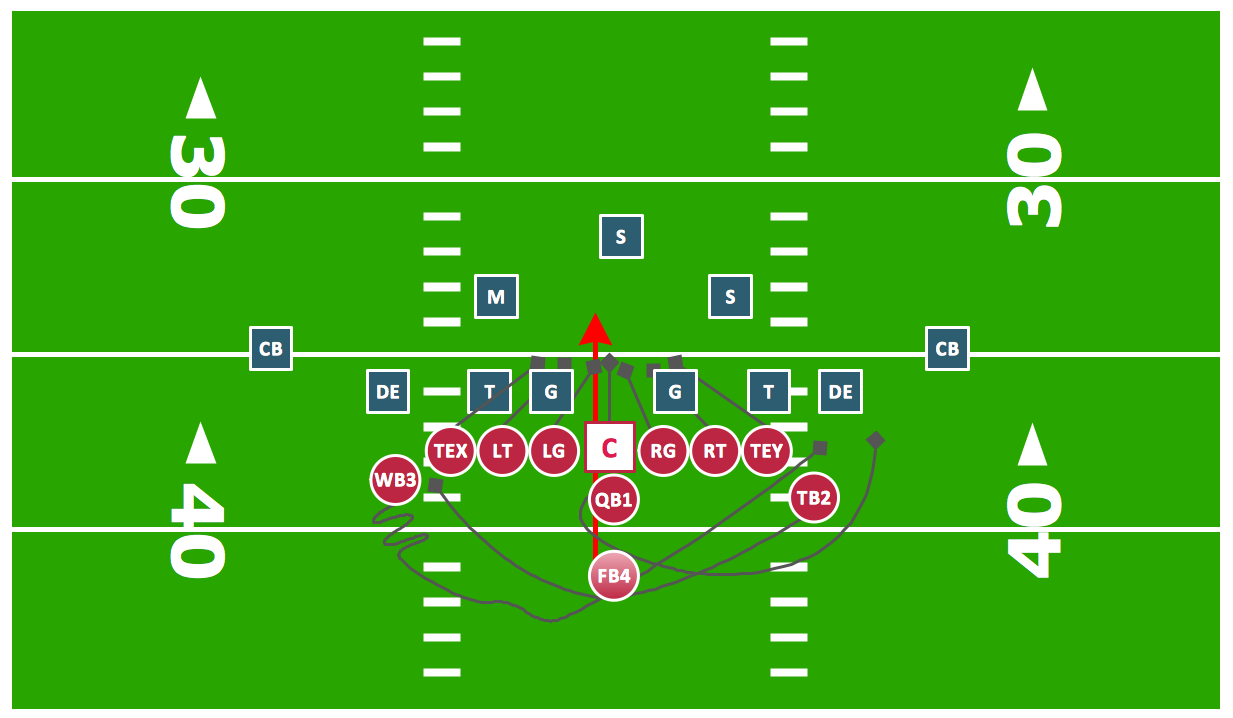
Offensive Play – Double Wing Wedge – Vector Graphic Diagram
- Draw A Football Field And Number The Player Wings
- Soccer ( Football ) Positions | Defensive Strategy Diagram – 46 ...
- Images Of A Football Field Numbers With Their Positions Of Players
- Football Pitch Wings Number
- Diagram Illustration Of Football Pitch And Wings Number
- Number And Wing Of Players In Football
- Formation Of Football Players Number And Wings Diagram
- Soccer ( Football ) Formation | Soccer | Basketball Court Diagram and ...
- Football Diagram And Position By Wings Numbers Image
- Soccer ( Football ) Formation | Design a Soccer ( Football ) Field ...


