Sprint Retrospective
Project ManagementIn PM solutions we support many project methodologies such as Agile and Simple Projects. Methodology solutions help in implementing best practices in project management. CS Odessa provides Toolbox solutions to support solving issues related to planning, tracking, milestones, events, resource usage, and other typical project management functions. Toolbox Solutions help you deal with common project situations in an extraordinary way. PM AgileBenefitsAll Agile meetings and documents are powered by mission adapted mind map templates, specially tuned for collaborative work. Tracking project Velocity is easy when using ConceptDraw Velocity diagram templates. ObjectiveSupport Agile methods such as user stories, iteration planning, burndown charts, backlogs, and velocity. Solution PurposeThese visual tools assist in the holding of Scrum-meetings, collaborative planning for Sprint, maintaining backlog, and calculating and reporting the Velocity of the team. Intended ForCompanies using Agile methodology; specifically, Scrum; Product Owners, Scrum Masters. Products and methodsIn the background of this solution we use mind mapping for visualization of key events and artifacts of Agile methodology. Key diagrams for visualization are made by ConceptDraw DIAGRAM |
Use Sprint Retrospective to visualize the Sprint Retrospective meeting agenda as a mind map.
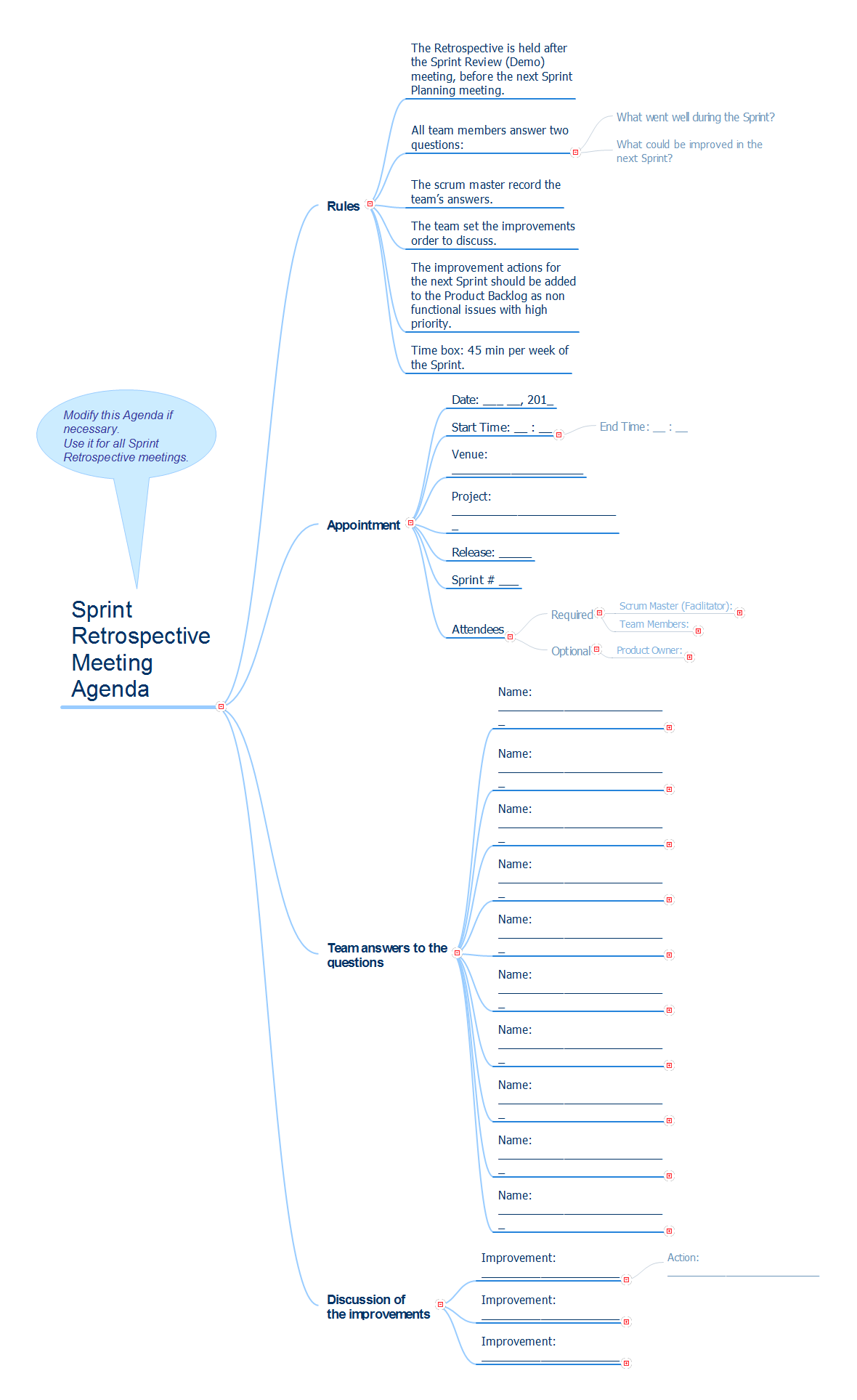
Example 1. Sprint Retrospective
Export to Outline
Sprint Retrospective Meeting Agenda
-
Rules
- The Retrospective is held after the Sprint Review (Demo) meeting, before the next Sprint Planning meeting.
-
All team members answer two questions:
- What went well during the Sprint?
- What could be improved in the next Sprint?
- The scrum master record the team’s answers.
- The team set the improvements order to discuss.
- The improvement actions for the next Sprint should be added to the Product Backlog as non functional issues with high priority.
- Time box: 45 min per week of the Sprint.
-
Appointment
- Date: ___ __, 201_
-
Start Time: __ : __
- End Time: __ : __
- Venue: ____________________
- Project: __________________________
- Release: _____
- Sprint # ___
-
Attendees
-
Required
-
Scrum Master (Facilitator):
- ______________________
-
Team Members:
- ______________________
- ______________________
- ______________________
- ______________________
- ______________________
- ______________________
- ______________________
- ______________________
- ______________________
-
Scrum Master (Facilitator):
-
Optional
-
Product Owner:
- ______________________
-
Product Owner:
-
Required
-
Team answers to the questions
-
Name: __________________________
-
What went well during the Sprint?
- Answer
-
What could be improved in the next Sprint?
- Answer
-
What went well during the Sprint?
-
Name: __________________________
-
What went well during the Sprint?
- Answer
-
What could be improved in the next Sprint?
- Answer
-
What went well during the Sprint?
-
Name: __________________________
-
What went well during the Sprint?
- Answer
-
What could be improved in the next Sprint?
- Answer
-
What went well during the Sprint?
-
Name: __________________________
-
What went well during the Sprint?
- Answer
-
What could be improved in the next Sprint?
- Answer
-
What went well during the Sprint?
-
Name: __________________________
-
What went well during the Sprint?
- Answer
-
What could be improved in the next Sprint?
- Answer
-
What went well during the Sprint?
-
Name: __________________________
-
What went well during the Sprint?
- Answer
-
What could be improved in the next Sprint?
- Answer
-
What went well during the Sprint?
-
Name: __________________________
-
What went well during the Sprint?
- Answer
-
What could be improved in the next Sprint?
- Answer
-
What went well during the Sprint?
-
Name: __________________________
-
What went well during the Sprint?
- Answer
-
What could be improved in the next Sprint?
- Answer
-
What went well during the Sprint?
-
Name: __________________________
-
What went well during the Sprint?
- Answer
-
What could be improved in the next Sprint?
- Answer
-
What went well during the Sprint?
-
Name: __________________________
-
What went well during the Sprint?
- Answer
-
What could be improved in the next Sprint?
- Answer
-
What went well during the Sprint?
-
Name: __________________________
-
Discussion of the improvements
-
Improvement: _____________________
- Action: __________________________
-
Improvement: _____________________
- Action: __________________________
-
Improvement: _____________________
- Action: __________________________
-
Improvement: _____________________
The Benefits for ConceptDraw MINDMAP Brainstorming Software
- ConceptDraw MINDMAP is effective for brainstorming, designing mind maps, idea generating, creative and lateral thinking, creativity and problem solving.
- ConceptDraw MINDMAP is ideal for team and personal work in Business, Marketing and Project Management.
- The libraries with large quantity of vector objects help to illustrate your mind maps and to make them bright, visual and comprehensible.
- Use of View Navigator tool lets create presentations from a mind map: you can simply select the map parts you want to present, sequence your slides, and preview the presentation.
- ConceptDraw MINDMAP provides wide capabilities of importing and exporting in various formats: Microsoft PowerPoint, Microsoft Word, MS Excel, Mindjet MindManager, image, HTML, PDF file.