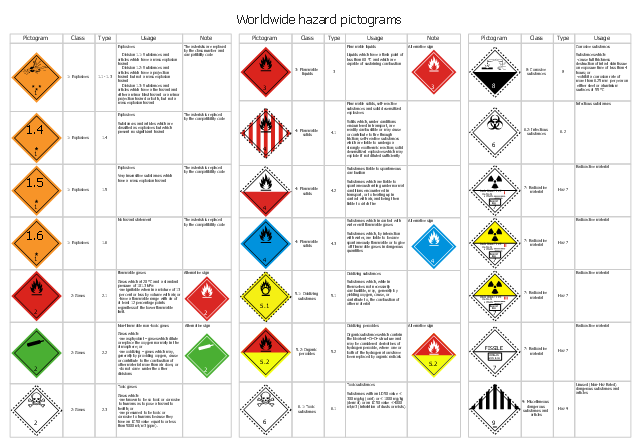
This transportation safety infographic shows the Worldwide hazard pictograms.
"Dangerous goods or hazardous goods are solids, liquids, or gases that can harm people, other living organisms, property, or the environment. They are often subject to chemical regulations. In the United States, United Kingdom and sometimes in Canada, dangerous goods are more commonly known as hazardous materials (abbreviated as HAZMAT or hazmat). Hazmat teams are personnel specially trained to handle dangerous goods, which include materials that are radioactive, flammable, explosive, corrosive, oxidizing, asphyxiating, biohazardous, toxic, pathogenic, or allergenic. Also included are physical conditions such as compressed gases and liquids or hot materials, including all goods containing such materials or chemicals, or may have other characteristics that render them hazardous in specific circumstances." [Dangerous goods. Wikipedia]
The GHS transport symbols infographic example "Worldwide hazard pictograms" was designed using ConceptDraw PRO software extended with the Transport Hazard Pictograms solution from the Engineering area of ConceptDraw Solution Park.
"Dangerous goods or hazardous goods are solids, liquids, or gases that can harm people, other living organisms, property, or the environment. They are often subject to chemical regulations. In the United States, United Kingdom and sometimes in Canada, dangerous goods are more commonly known as hazardous materials (abbreviated as HAZMAT or hazmat). Hazmat teams are personnel specially trained to handle dangerous goods, which include materials that are radioactive, flammable, explosive, corrosive, oxidizing, asphyxiating, biohazardous, toxic, pathogenic, or allergenic. Also included are physical conditions such as compressed gases and liquids or hot materials, including all goods containing such materials or chemicals, or may have other characteristics that render them hazardous in specific circumstances." [Dangerous goods. Wikipedia]
The GHS transport symbols infographic example "Worldwide hazard pictograms" was designed using ConceptDraw PRO software extended with the Transport Hazard Pictograms solution from the Engineering area of ConceptDraw Solution Park.
GHS hazard symbols
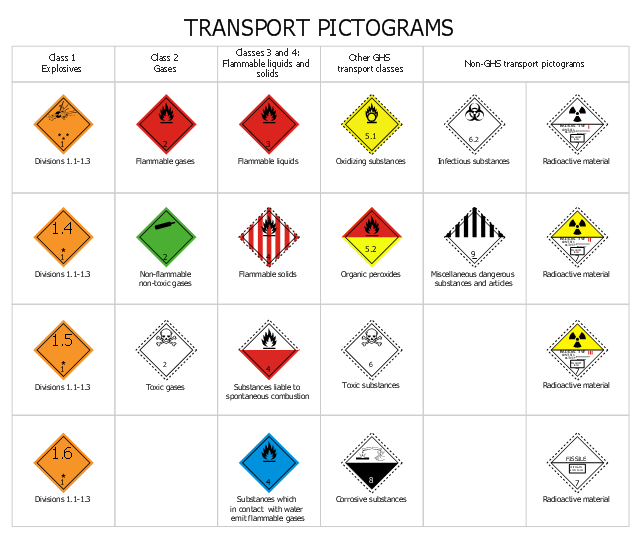
This transportation safety infographic shows the hazard pictograms for Class 1 Explosives, Class 2 Gases, Class 3 Flammable liquids, Class 4 Flammable solids, Class 5 Oxidizers, Class 6 Toxic substances, Class 7 Radioactive materials, Class 8 Corrosive substances, Class 9 Miscellaneous dangerous substances.
The GHS hazard symbols infographic example "Transport pictograms" was designed using ConceptDraw PRO software extended with the Transport Hazard Pictograms solution from the Engineering area of ConceptDraw Solution Park.
The GHS hazard symbols infographic example "Transport pictograms" was designed using ConceptDraw PRO software extended with the Transport Hazard Pictograms solution from the Engineering area of ConceptDraw Solution Park.
GHS hazard symbols
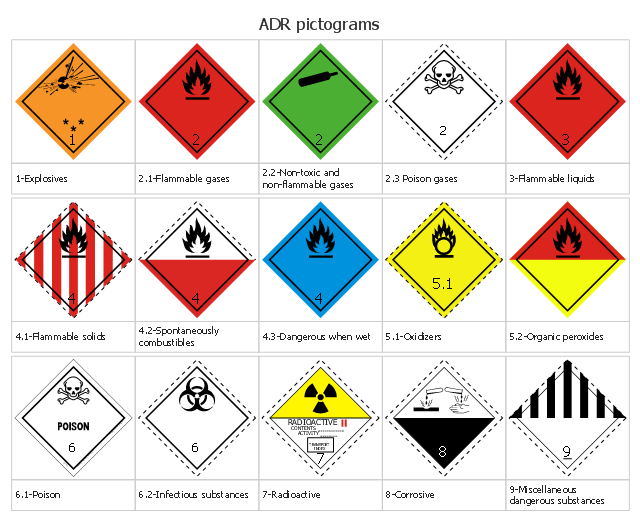
This transportation safety infographic shows the ADR pictograms.
"ADR (formally, the European Agreement concerning the International Carriage of Dangerous Goods by Road (ADR)) is a 1957 United Nations treaty that governs transnational transport of hazardous materials. "ADR" is derived from the French name for the treaty: Accord européen relatif au transport international des marchandises Dangereuses par Route). ... The agreement itself is brief and simple, and its most important article is article 2. This article states that with the exception of certain exceptionally dangerous materials, hazardous materials may in general be transported internationally in wheeled vehicles, provided that two sets of conditions be met:
1. Annex A regulates the merchandise involved, notably their packaging and labels.
2. Annex B regulates the construction, equipment, and use of vehicles for the transport of hazardous materials." [ADR (treaty). Wikipedia]
The GHS transport hazard symbols infographic example "ADR pictograms" was designed using ConceptDraw PRO software extended with the Transport Hazard Pictograms solution from the Engineering area of ConceptDraw Solution Park.
"ADR (formally, the European Agreement concerning the International Carriage of Dangerous Goods by Road (ADR)) is a 1957 United Nations treaty that governs transnational transport of hazardous materials. "ADR" is derived from the French name for the treaty: Accord européen relatif au transport international des marchandises Dangereuses par Route). ... The agreement itself is brief and simple, and its most important article is article 2. This article states that with the exception of certain exceptionally dangerous materials, hazardous materials may in general be transported internationally in wheeled vehicles, provided that two sets of conditions be met:
1. Annex A regulates the merchandise involved, notably their packaging and labels.
2. Annex B regulates the construction, equipment, and use of vehicles for the transport of hazardous materials." [ADR (treaty). Wikipedia]
The GHS transport hazard symbols infographic example "ADR pictograms" was designed using ConceptDraw PRO software extended with the Transport Hazard Pictograms solution from the Engineering area of ConceptDraw Solution Park.
GHS hazard symbols
 Transport Hazard Pictograms
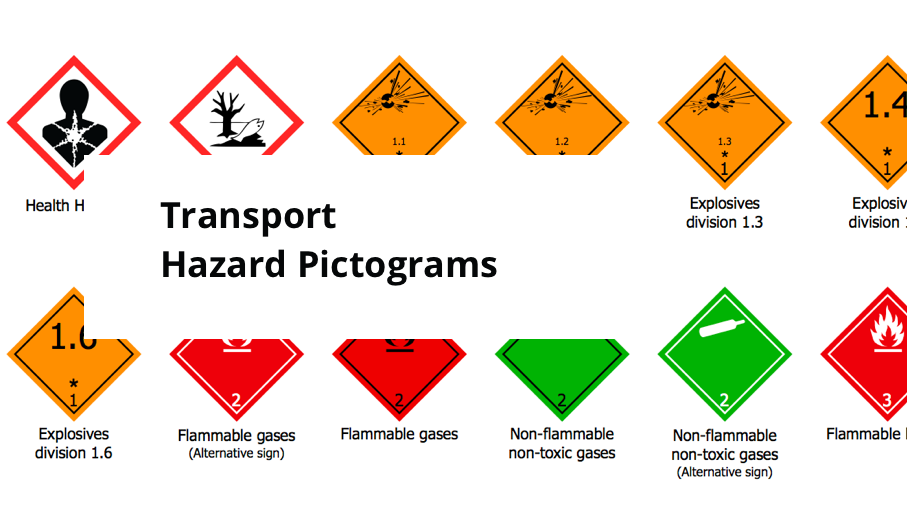
Transport Hazard Pictograms solution includes large variety of specially developed samples with transport hazard symbols and pictograms, and the whole set of predesigned vector transport GHS pictograms download and used with ease from the Transport Hazard Pictograms library. Apply them for quick designing professional-looking infographics and diagrams, use them to create warning signboards and announcements on all stages of the transportation process, to place them on the transport vehicles and warehouses of transportation companies, at the transport documentation and on the websites of transport and logistics companies.
 GHS Hazard Pictograms
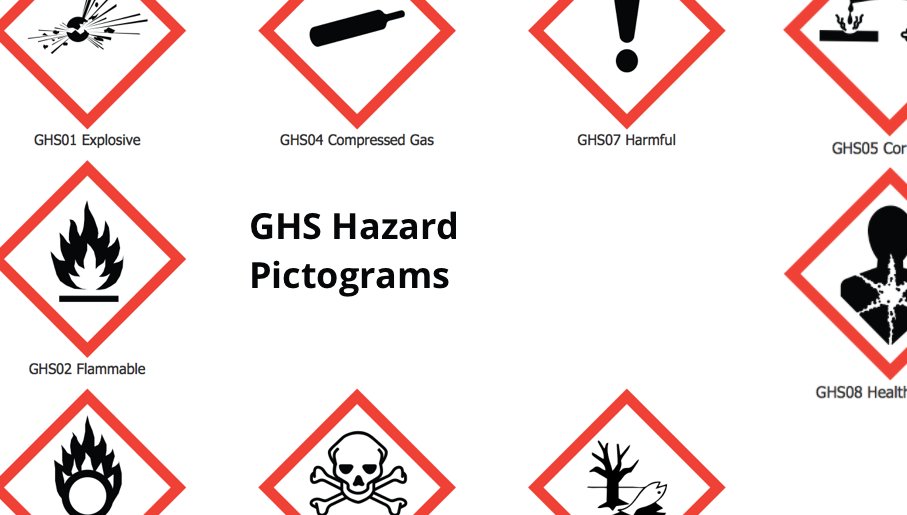
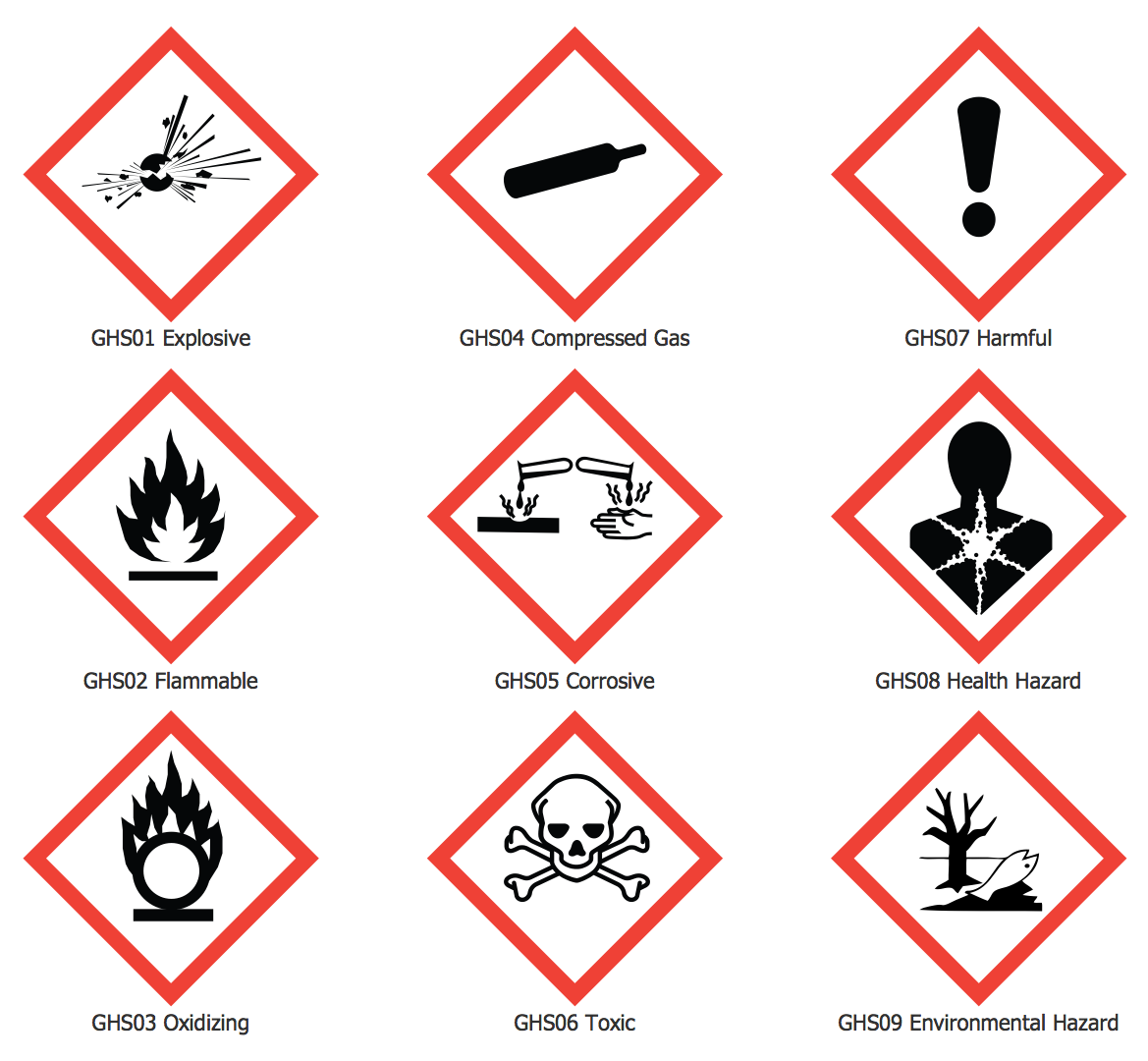
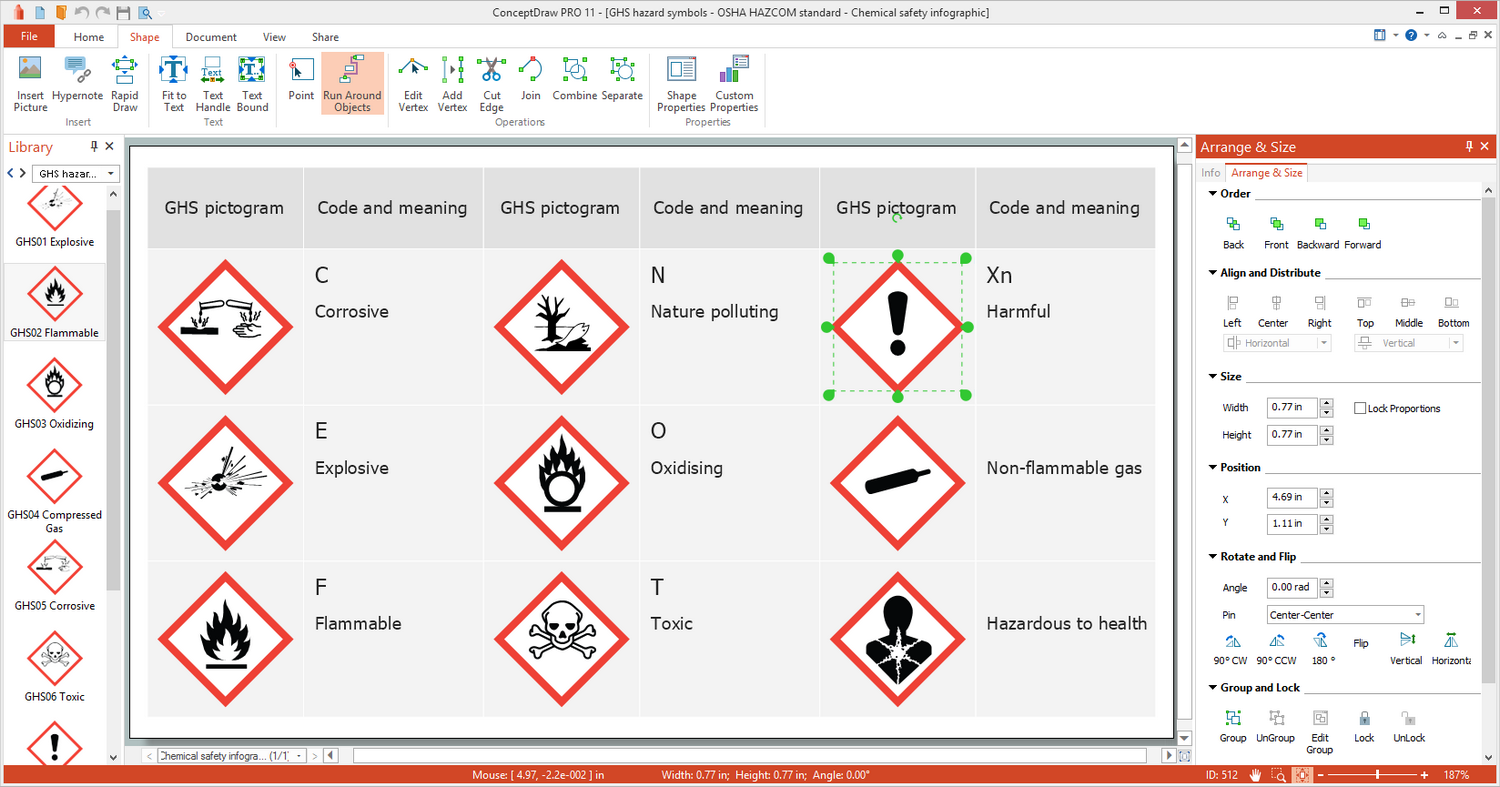
GHS Hazard Pictograms solution contains the set of predesigned standard GHS pictograms, Hazardous symbols, and Hazard communication pictograms, approved and agreed by UN in Globally Harmonized System of Classification and Labelling of Chemicals (GHS). They can be used for quick and simple designing accurate and professional-looking infographics, diagrams, warning announcements, signboards, posters, precautionary declarations, regulatory documents, and for representing the main items of OSHA HAZCOM Standard.
Hazard Pictograms
GHS Labels Meanings
The vector stencils library "Chemical engineering" contains 24 symbols of chemical and process engineering equipment.
Use these shapes for drawing block flow diagrams (BFD), process flow diagrams (PFD), piping and instrumentation diagrams (P&ID), and water flow diagrams.
"Chemical engineering is a branch of engineering that applies the natural (or experimental) sciences (e.g., chemistry and physics) and life sciences (e.g. biology, microbiology and biochemistry) together with mathematics and economics to production, transformation, transportation and proper usage of chemicals, materials and energy. It essentially deals with the engineering of chemicals, energy and the processes that create and/ or convert them. Modern chemical engineers are concerned with processes that convert raw-materials or (cheap)chemicals into more useful or valuable forms. In addition, they are also concerned with pioneering valuable materials and related techniques – which are often essential to related fields such as nanotechnology, fuel cells and bioengineering. Within chemical engineering, two broad subgroups include design, manufacture, and operation of plants and machinery in industrial chemical and related processes ("chemical process engineers") and development of new or adapted substances for products ranging from foods and beverages to cosmetics to cleaners to pharmaceutical ingredients, among many other products ("chemical product engineers")." [Chemical engineering. Wikipedia]
The example "Design elements - Chemical engineering" was created using the ConceptDraw PRO diagramming and vector drawing software extended with the Chemical and Process Engineering solution from the Engineering area of ConceptDraw Solution Park.
Use these shapes for drawing block flow diagrams (BFD), process flow diagrams (PFD), piping and instrumentation diagrams (P&ID), and water flow diagrams.
"Chemical engineering is a branch of engineering that applies the natural (or experimental) sciences (e.g., chemistry and physics) and life sciences (e.g. biology, microbiology and biochemistry) together with mathematics and economics to production, transformation, transportation and proper usage of chemicals, materials and energy. It essentially deals with the engineering of chemicals, energy and the processes that create and/ or convert them. Modern chemical engineers are concerned with processes that convert raw-materials or (cheap)chemicals into more useful or valuable forms. In addition, they are also concerned with pioneering valuable materials and related techniques – which are often essential to related fields such as nanotechnology, fuel cells and bioengineering. Within chemical engineering, two broad subgroups include design, manufacture, and operation of plants and machinery in industrial chemical and related processes ("chemical process engineers") and development of new or adapted substances for products ranging from foods and beverages to cosmetics to cleaners to pharmaceutical ingredients, among many other products ("chemical product engineers")." [Chemical engineering. Wikipedia]
The example "Design elements - Chemical engineering" was created using the ConceptDraw PRO diagramming and vector drawing software extended with the Chemical and Process Engineering solution from the Engineering area of ConceptDraw Solution Park.
Chemical engineering symbols

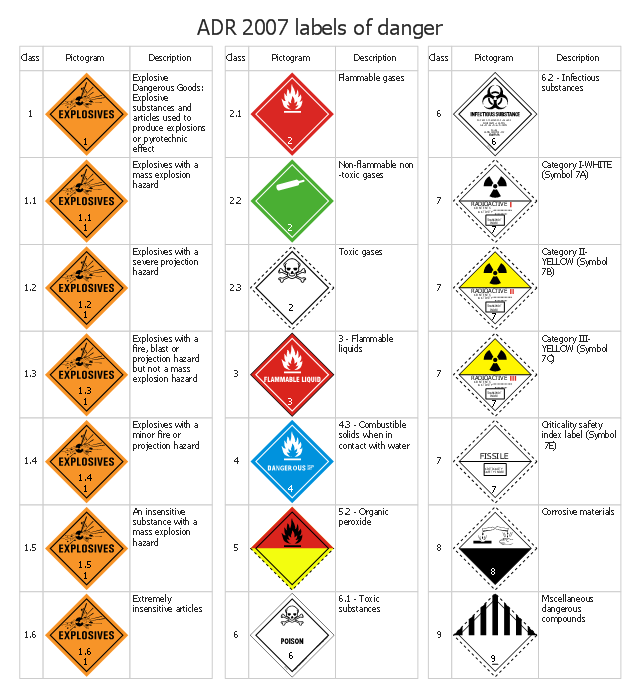
This transportation safety infographic shows the ADR 2007 labels of danger.
"Hazard symbols according to the Accord européen relatif au transport international des marchandises Dangereuses par Route (ADR) (European agreement about international transport of hazardous goods by road) and Reglement concernant le transport international ferroviaire de marchandises Dangereuses (RID) (Rules about international railway transport of hazardous goods), promoted by UNECE ECOSOC (Dangerous Goods, unece.org).
Also used by International Maritime Code for Dangerous Goods (IMDG) for overseas shipping by UN-IMO, International Maritime Organization (IMDG-Code, imo.org)." [ADR labels of danger. Wikimedia Commons]
The GHS transport hazard symbols infographic example "ADR 2007 labels of danger" was designed using ConceptDraw PRO software extended with the Transport Hazard Pictograms solution from the Engineering area of ConceptDraw Solution Park.
"Hazard symbols according to the Accord européen relatif au transport international des marchandises Dangereuses par Route (ADR) (European agreement about international transport of hazardous goods by road) and Reglement concernant le transport international ferroviaire de marchandises Dangereuses (RID) (Rules about international railway transport of hazardous goods), promoted by UNECE ECOSOC (Dangerous Goods, unece.org).
Also used by International Maritime Code for Dangerous Goods (IMDG) for overseas shipping by UN-IMO, International Maritime Organization (IMDG-Code, imo.org)." [ADR labels of danger. Wikimedia Commons]
The GHS transport hazard symbols infographic example "ADR 2007 labels of danger" was designed using ConceptDraw PRO software extended with the Transport Hazard Pictograms solution from the Engineering area of ConceptDraw Solution Park.
GHS hazard symbols
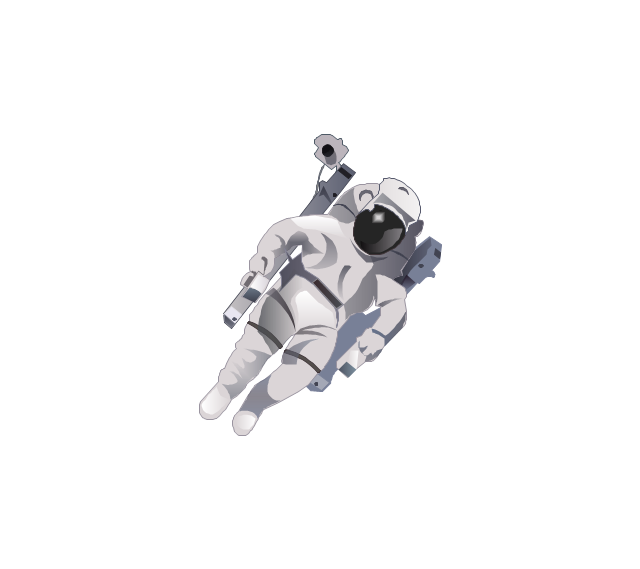
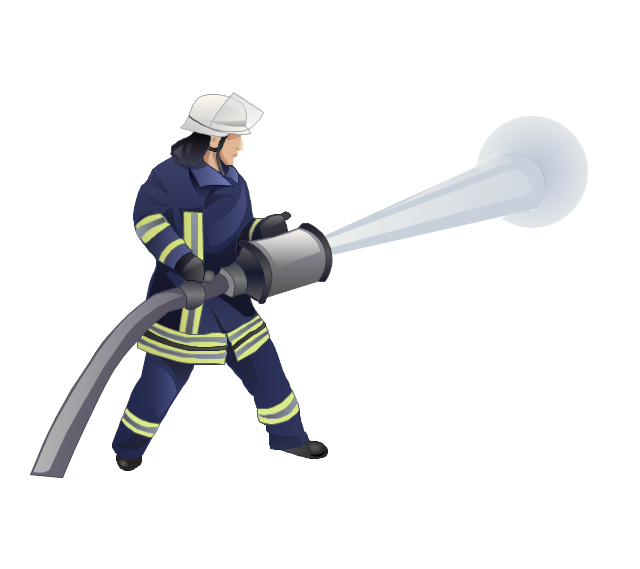
The vector stencils library "Professions" contains 58 people clipart images of different professions you can use in your presentations, illustrations and infographics.
"Electronic clip art is available in several different file formats. It is important for clip art users to understand the differences between file formats so that they can use an appropriate image file and get the resolution and detail results they need.
Clip art file formats are divided into 2 different types: bitmap or vector graphics. ...
In contrast to the grid format of bitmap images, Vector graphics file formats use geometric modeling to describe an image as a series of points, lines, curves, and polygons. Because the image is described using geometric data instead of fixed pixels, the image can be scaled to any size while retaining "resolution independence", meaning that the image can be printed at the highest resolution a printer supports, resulting in a clear, crisp image. Vector file formats are usually superior in resolution and ease of editing as compared to bitmap file formats, but are not as widely supported by software and are not well-suited for storing pixel-specific data such as scanned photographs. In the early years of electronic clip art, vector illustrations were limited to simple line art representations." [Clip art. Wikipedia]
The clip art example "Professions - Vector stencils library" was created using the ConceptDraw PRO diagramming and vector drawing software extended with the People solution from the Illustration area of ConceptDraw Solution Park.
www.conceptdraw.com/ solution-park/ illustrations-people
"Electronic clip art is available in several different file formats. It is important for clip art users to understand the differences between file formats so that they can use an appropriate image file and get the resolution and detail results they need.
Clip art file formats are divided into 2 different types: bitmap or vector graphics. ...
In contrast to the grid format of bitmap images, Vector graphics file formats use geometric modeling to describe an image as a series of points, lines, curves, and polygons. Because the image is described using geometric data instead of fixed pixels, the image can be scaled to any size while retaining "resolution independence", meaning that the image can be printed at the highest resolution a printer supports, resulting in a clear, crisp image. Vector file formats are usually superior in resolution and ease of editing as compared to bitmap file formats, but are not as widely supported by software and are not well-suited for storing pixel-specific data such as scanned photographs. In the early years of electronic clip art, vector illustrations were limited to simple line art representations." [Clip art. Wikipedia]
The clip art example "Professions - Vector stencils library" was created using the ConceptDraw PRO diagramming and vector drawing software extended with the People solution from the Illustration area of ConceptDraw Solution Park.
www.conceptdraw.com/ solution-park/ illustrations-people
Builder 1

System administrator

Worker of conveyor

Clerk 1

Clerk 2

Student 2

Student 3

Student 1

Dispatcher 1

Accountant

Gardener

Lawyer

Jurist

Judge

Consultant

Manager

Director

Programmer

Architect

Pilot

Policeman

Secretary

Security officer

Clerk 3

Musician

Presenter

Athlete

Artist

Announcer

Photographer

Hairdresser

Florist

Spaceman
Engineer

Reporter

Tailor

Dispatcher 2

Biologist

Chemist

Dentist

Priest

Soldier

Doctor

Driver

Carpenter

Fireman
Seaman

Builder 2

Postman

Miner

Waiter

Cleaner

Cashier

Shop assistant

Cook

Flight attendant

Teacher

Hall porter

- Transport Hazard Pictograms | How To Design Warning Infographics ...
- Block Diagram Of Engineering Materials
- ADR pictograms | ADR 2007 labels of danger | Worldwide hazard ...
- GHS hazard symbols | Design elements - GHS hazard pictograms ...
- Hazard Chemical Sign | GHS Hazard Pictograms | Fire and ...
- GHS hazard symbols | Design elements - GHS hazard pictograms ...
- Design elements - Industrial equipment | Chemical and Process ...
- Process Flow Diagram Symbols | Chemical Engineering | Chemical ...
- Chemical and Process Engineering | Design elements - Chemical ...
- How to Draw a Chemical Process Flow Diagram | Design elements ...


