HelpDesk
How to Create a House of Quality Diagram
 House of Quality
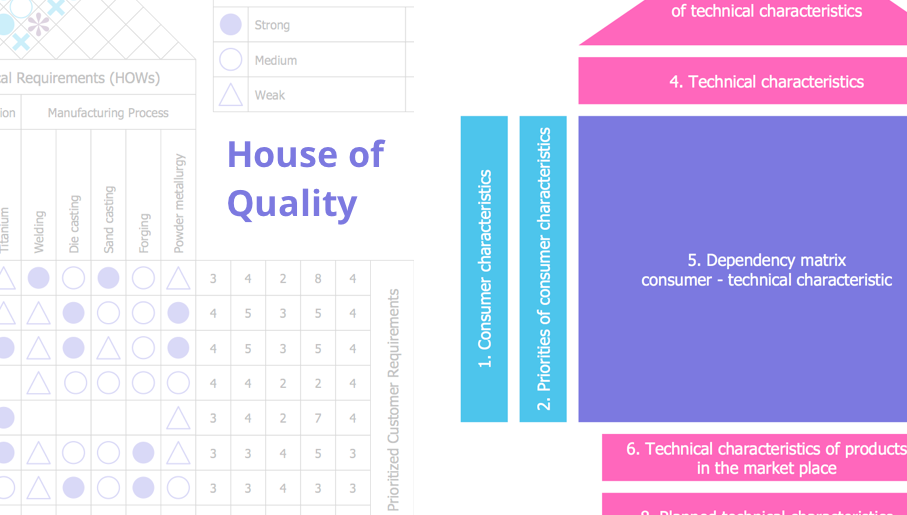
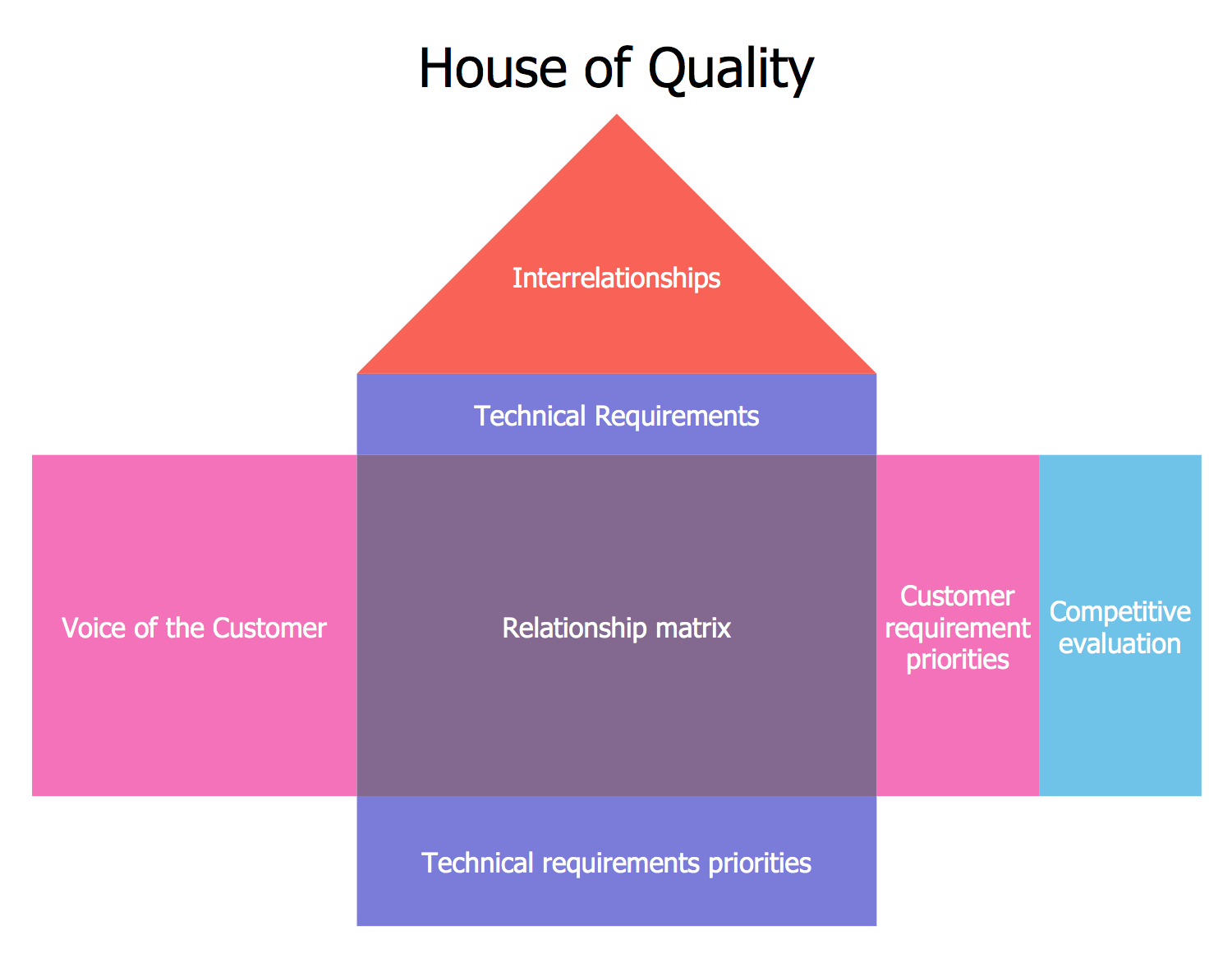
House of Quality solution provides the powerful drawing tools, numerous specific samples and examples, and set of vector design elements of House of Quality shapes and symbols, which will help you in application the Quality function deployment (QFD) methodology and in easy creation the House of Quality Matrices intended for satisfaction the consumers' desires and requirements, for representing them in a visual way and then transformation into the targets and technical requirements to be followed for development the best products.
House of Quality Matrix Software

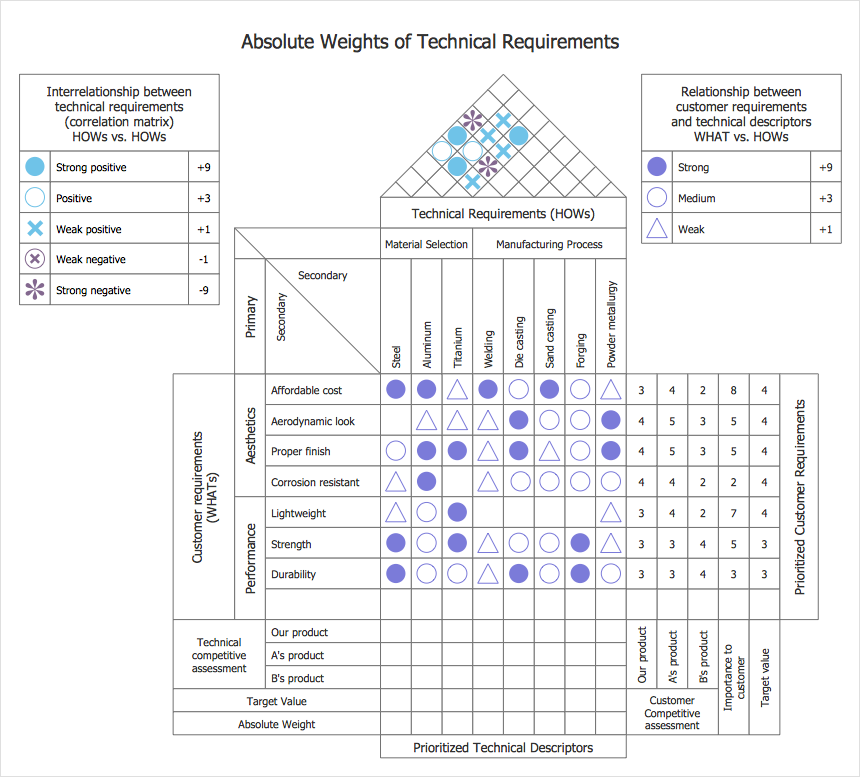
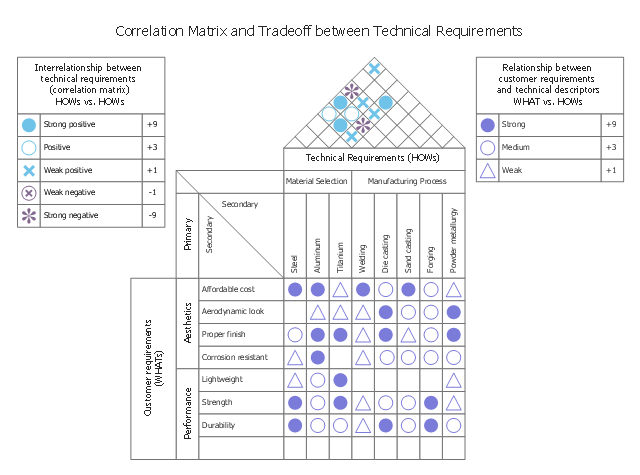
This house of quality sample illustrates correlation matrix.
It was designed on the base of the figure 3-5 in Lecture "How QFD helps in product quality improvement?" from the website of National Programme on Technology Enhanced Learning (NPTEL), India. [nptel.ac.in/ courses/ 110101010/ downloads/ mod3/ Module%20 III-Lec1.pdf]
Distributed under Creative Commons Attribution-ShareAlike 4.0 International (CC BY-SA 4.0) [creativecommons.org/ licenses/ by-sa/ 4.0/ ]
"After drafting the relationship matrix, it is evaluated for any empty row or column. An empty row indicates that a customer voice is not being addressed by any technical descriptors. Thus, the customer expectation is not being met. Any blank column indicates that the technical requirement is unnecessary, as it does not address any VOC.
The roof of the house of quality, expressed as correlation matrix, is used to identify any interrelationships between the technical descriptors (Figure 3-5). Symbols are used to describe the strength of the interrelationships. Symbols generally preferred are:
- A ‘solid circle’ represents a strong positive relationship.
- A ‘circle’ represents a positive relationship.
- An ‘X’ represents a negative relationship.
- An ‘asterisk’ represents a strong negative relationship." [nptel.ac.in/ courses/ 110101010/ modules/ module3/ lec1/ 1.7.html]
The HOQ example "House of Quality - correlation matrix" was designed using ConceptDraw PRO software extended with House of Quality solution from Quality area of ConceptDraw PRO Solution Park.
It was designed on the base of the figure 3-5 in Lecture "How QFD helps in product quality improvement?" from the website of National Programme on Technology Enhanced Learning (NPTEL), India. [nptel.ac.in/ courses/ 110101010/ downloads/ mod3/ Module%20 III-Lec1.pdf]
Distributed under Creative Commons Attribution-ShareAlike 4.0 International (CC BY-SA 4.0) [creativecommons.org/ licenses/ by-sa/ 4.0/ ]
"After drafting the relationship matrix, it is evaluated for any empty row or column. An empty row indicates that a customer voice is not being addressed by any technical descriptors. Thus, the customer expectation is not being met. Any blank column indicates that the technical requirement is unnecessary, as it does not address any VOC.
The roof of the house of quality, expressed as correlation matrix, is used to identify any interrelationships between the technical descriptors (Figure 3-5). Symbols are used to describe the strength of the interrelationships. Symbols generally preferred are:
- A ‘solid circle’ represents a strong positive relationship.
- A ‘circle’ represents a positive relationship.
- An ‘X’ represents a negative relationship.
- An ‘asterisk’ represents a strong negative relationship." [nptel.ac.in/ courses/ 110101010/ modules/ module3/ lec1/ 1.7.html]
The HOQ example "House of Quality - correlation matrix" was designed using ConceptDraw PRO software extended with House of Quality solution from Quality area of ConceptDraw PRO Solution Park.
HOQ of a handlebar stem in a bicycle
House of Quality
This house of quality matrix sample was designed on the base of the Wikimedia Commons file: Casa de la calidad QFD.png.
[commons.wikimedia.org/ wiki/ File:A1_ House_ of_ Quality.png]
This file is made available under the Creative Commons CC0 1.0 Universal Public Domain Dedication. [creativecommons.org/ publicdomain/ zero/ 1.0/ deed.en]
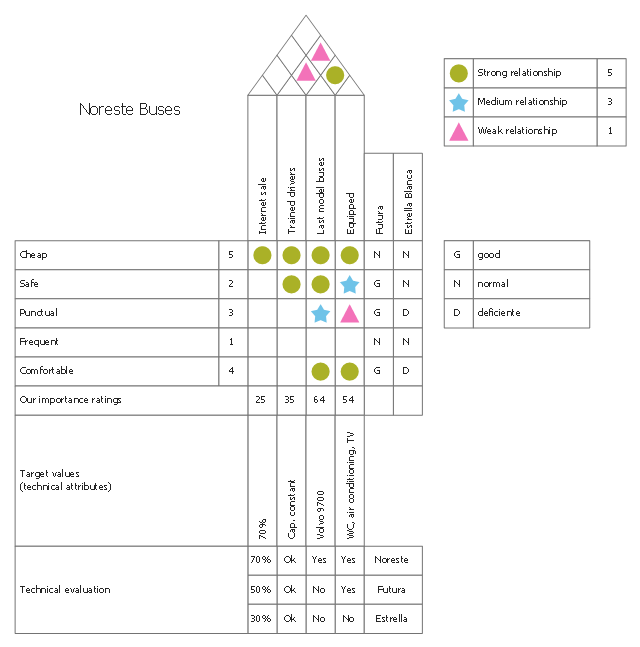
"The house of quality, a part of QFD, identifies and classifies customer desires, identifies the importance of those desires, identifies engineering characteristics which may be relevant to those desires, correlates the two, allows for verification of those correlations, and then assigns objectives and priorities for the system requirements. This process can be applied at any system composition level (e.g. system, subsystem, or component) in the design of a product, and can allow for assessment of different abstractions of a system." [Quality function deployment. Wikipedia]
The HOQ example "House of quality of buses" was designed using ConceptDraw PRO software extended with House of Quality solution from Quality area of ConceptDraw PRO Solution Park.
[commons.wikimedia.org/ wiki/ File:A1_ House_ of_ Quality.png]
This file is made available under the Creative Commons CC0 1.0 Universal Public Domain Dedication. [creativecommons.org/ publicdomain/ zero/ 1.0/ deed.en]
"The house of quality, a part of QFD, identifies and classifies customer desires, identifies the importance of those desires, identifies engineering characteristics which may be relevant to those desires, correlates the two, allows for verification of those correlations, and then assigns objectives and priorities for the system requirements. This process can be applied at any system composition level (e.g. system, subsystem, or component) in the design of a product, and can allow for assessment of different abstractions of a system." [Quality function deployment. Wikipedia]
The HOQ example "House of quality of buses" was designed using ConceptDraw PRO software extended with House of Quality solution from Quality area of ConceptDraw PRO Solution Park.
HOQ matrix
This house of quality matrix sample was designed on the base of the Wikimedia Commons file: House of Quality.jpg.
[commons.wikimedia.org/ wiki/ File:House_ of_ Quality.jpg]
This file is licensed under the Creative Commons Attribution-Share Alike 4.0 International license. [creativecommons.org/ licenses/ by-sa/ 4.0/ deed.en]
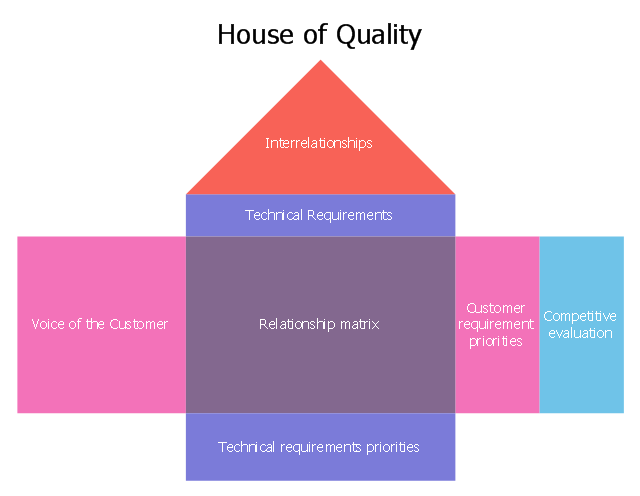
"Quality Function Deployment (QFD) uses a matrix format to capture a number of issues that are vital to the planning process. The House of Quality Matrix is the most recognized and widely used form of this method. It translates customer requirements, based on marketing research and benchmarking data, into an appropriate number of engineering targets to be met by a new product design. Basically, it is the nerve center and the engine that drives the entire QFD process." [Tapke, Jennifer; Muller, Alyson; Johnson, Greg; Siec, Josh. "House of Quality: Steps in Understanding the House of Quality" (PDF). IE 361. Iowa State University. www.public.iastate.edu/ ~vardeman/ IE361/ f01mini/ johnson.pdf]
The HOQ example "House of quality" was designed using ConceptDraw PRO software extended with House of Quality solution from Quality area of ConceptDraw PRO Solution Park.
[commons.wikimedia.org/ wiki/ File:House_ of_ Quality.jpg]
This file is licensed under the Creative Commons Attribution-Share Alike 4.0 International license. [creativecommons.org/ licenses/ by-sa/ 4.0/ deed.en]
"Quality Function Deployment (QFD) uses a matrix format to capture a number of issues that are vital to the planning process. The House of Quality Matrix is the most recognized and widely used form of this method. It translates customer requirements, based on marketing research and benchmarking data, into an appropriate number of engineering targets to be met by a new product design. Basically, it is the nerve center and the engine that drives the entire QFD process." [Tapke, Jennifer; Muller, Alyson; Johnson, Greg; Siec, Josh. "House of Quality: Steps in Understanding the House of Quality" (PDF). IE 361. Iowa State University. www.public.iastate.edu/ ~vardeman/ IE361/ f01mini/ johnson.pdf]
The HOQ example "House of quality" was designed using ConceptDraw PRO software extended with House of Quality solution from Quality area of ConceptDraw PRO Solution Park.
HOQ matrix
This house of quality matrix sample was designed on the base of the Wikimedia Commons file: Building the House of Quality - Example.jpg. [commons.wikimedia.org/ wiki/ File:Building_ the_ House_ of_ Quality_ -_ Example.jpg]
This file is licensed under the Creative Commons Attribution-Share Alike 4.0 International license. [creativecommons.org/ licenses/ by-sa/ 4.0/ deed.en]
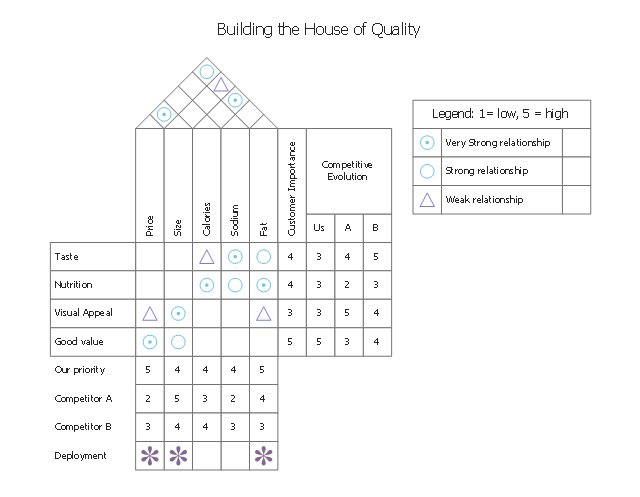
"The “house of quality,” the basic design tool of the management approach known as quality function deployment (QFD)...
The foundation of the house of quality is the belief that products should be designed to reflect customers’ desires and tastes—so marketing people, design engineers, and manufacturing staff must work closely together from the time a product is first conceived.
The house of quality is a kind of conceptual map that provides the means for interfunctional planning and communications. People with different problems and responsibilities can thrash out design priorities while referring to patterns of evidence on the house’s grid." [Hauser, John R.; Clausing, Don. "The House of Quality". Harvard Business Review. No. May 1988. hbr.org/ 1988/ 05/ the-house-of-quality]
The HOQ example "Building the House of Quality" was designed using ConceptDraw PRO software extended with House of Quality solution from Quality area of ConceptDraw PRO Solution Park.
This file is licensed under the Creative Commons Attribution-Share Alike 4.0 International license. [creativecommons.org/ licenses/ by-sa/ 4.0/ deed.en]
"The “house of quality,” the basic design tool of the management approach known as quality function deployment (QFD)...
The foundation of the house of quality is the belief that products should be designed to reflect customers’ desires and tastes—so marketing people, design engineers, and manufacturing staff must work closely together from the time a product is first conceived.
The house of quality is a kind of conceptual map that provides the means for interfunctional planning and communications. People with different problems and responsibilities can thrash out design priorities while referring to patterns of evidence on the house’s grid." [Hauser, John R.; Clausing, Don. "The House of Quality". Harvard Business Review. No. May 1988. hbr.org/ 1988/ 05/ the-house-of-quality]
The HOQ example "Building the House of Quality" was designed using ConceptDraw PRO software extended with House of Quality solution from Quality area of ConceptDraw PRO Solution Park.
HOQ matrix
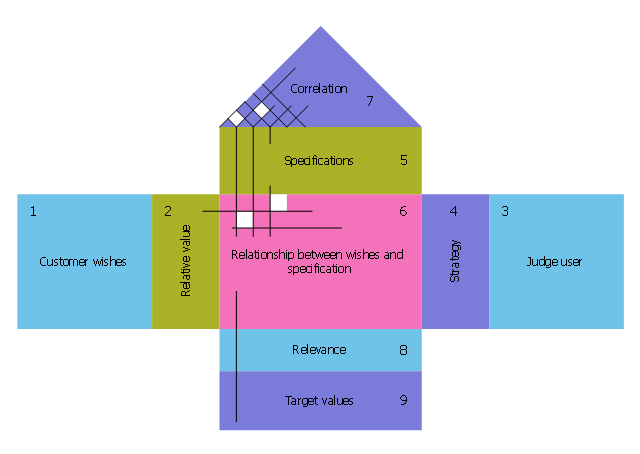
This house of quality matrix template was designed on the base of the Wikimedia Commons file: House of quality 9 step.png.
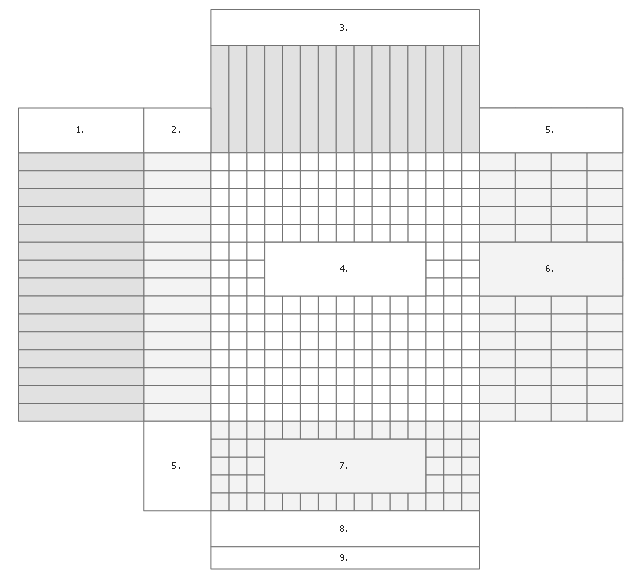
"An example of House of Quality including numbers (1-9) for easier relation between text and image."
[commons.wikimedia.org/ wiki/ File:House_ of_ quality_ 9_ step.png]
"Product Design. Initially, information about customer requirements must be collected. Once done, these should be converted into qualitative properties in the form of design. A tool used to facilitate this is the House of Quality, which is based on a number of processes that generally follow the list below.
1. Customer characteristics
2. Priorities of customer characteristics (scale 1-5)
3. Technical characteristics
4. Relationships between customer and technical characteristics (1.3.9)
5. Competing products
6. Rating of products on the market by customer characteristics (scale 1-5)
7. Rating of products on the market by technical characteristics (scale 1-5)
8. Rating and comparison of measurable values for product properties
9. The tool converts the information into measurable results
Then a more precise requirement specification can be made. Where product requirements and technical characteristics are developed in detail." [sv.wikipedia.org/ wiki/ Quality_ function_ deployment]
The HOQ template "House of quality 9 step" was designed using ConceptDraw PRO software extended with House of Quality solution from Quality area of ConceptDraw PRO Solution Park.
"An example of House of Quality including numbers (1-9) for easier relation between text and image."
[commons.wikimedia.org/ wiki/ File:House_ of_ quality_ 9_ step.png]
"Product Design. Initially, information about customer requirements must be collected. Once done, these should be converted into qualitative properties in the form of design. A tool used to facilitate this is the House of Quality, which is based on a number of processes that generally follow the list below.
1. Customer characteristics
2. Priorities of customer characteristics (scale 1-5)
3. Technical characteristics
4. Relationships between customer and technical characteristics (1.3.9)
5. Competing products
6. Rating of products on the market by customer characteristics (scale 1-5)
7. Rating of products on the market by technical characteristics (scale 1-5)
8. Rating and comparison of measurable values for product properties
9. The tool converts the information into measurable results
Then a more precise requirement specification can be made. Where product requirements and technical characteristics are developed in detail." [sv.wikipedia.org/ wiki/ Quality_ function_ deployment]
The HOQ template "House of quality 9 step" was designed using ConceptDraw PRO software extended with House of Quality solution from Quality area of ConceptDraw PRO Solution Park.
HOQ matrix
This house of quality matrix sample was designed on the base of the Wikimedia Commons file: A1 House of Quality.png.
"House of Quality is a diagram, resembling a house, used for defining the relationship between customer desires and the firm/ product capabilities" [commons.wikimedia.org/ wiki/ File:A1_ House_ of_ Quality.png]
The HOQ example "House of quality diagram" was designed using ConceptDraw PRO software extended with House of Quality solution from Quality area of ConceptDraw PRO Solution Park.
"House of Quality is a diagram, resembling a house, used for defining the relationship between customer desires and the firm/ product capabilities" [commons.wikimedia.org/ wiki/ File:A1_ House_ of_ Quality.png]
The HOQ example "House of quality diagram" was designed using ConceptDraw PRO software extended with House of Quality solution from Quality area of ConceptDraw PRO Solution Park.
HOQ matrix
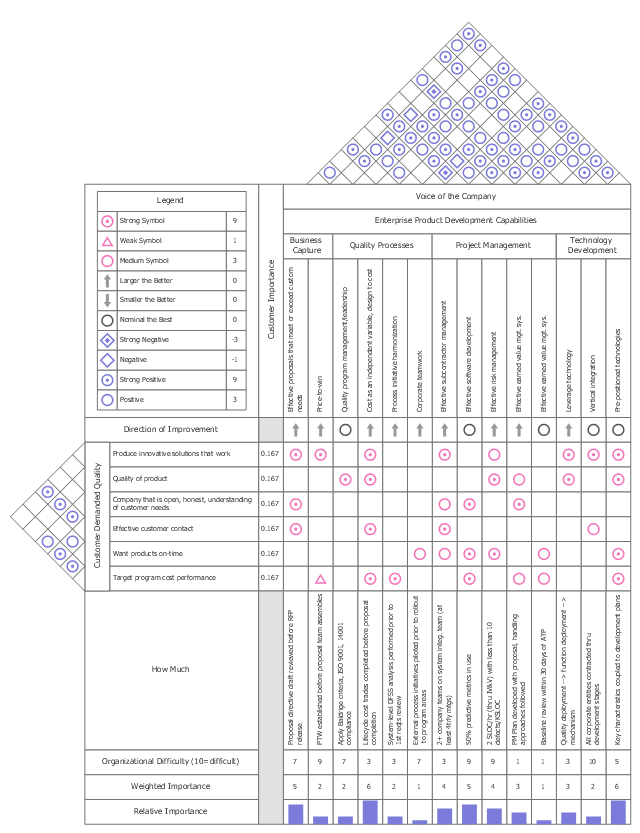
This house of quality matrix sample was designed on the base of the Wikimedia Commons file: Het kwaliteitshuis.png.
[commons.wikimedia.org/ wiki/ File:Het_ kwaliteitshuis.png]
This file is licensed under the Creative Commons Attribution-Share Alike 3.0 Unported license. [creativecommons.org/ licenses/ by-sa/ 3.0/ deed.en]
"The House of Quality is an assembly of several deployment hierarchies and tables, including the Demanded Quality Hierarchy, Quality Characteristics Hierarchy, the relationships matrix, the Quality Planning Table, and Design Planning Table. It is a table that connects dots between the Voice of the Customer and the Voice of the Engineer." ["Frequently Asked Questions about QFD". QFDI.org. QFD Institute. web.archive.org/ web/ 20131213044623/ http:/ / www.qfdi.org/ what_ is_ qfd/ faqs_ about_ qfd.htm#What%20 is%20 the%20 House%20 of%20 Quality%20 Why%20 it%20 isnt%20 a%20 QFD]
The HOQ example "QFD house of quality" was designed using ConceptDraw PRO software extended with House of Quality solution from Quality area of ConceptDraw PRO Solution Park.
[commons.wikimedia.org/ wiki/ File:Het_ kwaliteitshuis.png]
This file is licensed under the Creative Commons Attribution-Share Alike 3.0 Unported license. [creativecommons.org/ licenses/ by-sa/ 3.0/ deed.en]
"The House of Quality is an assembly of several deployment hierarchies and tables, including the Demanded Quality Hierarchy, Quality Characteristics Hierarchy, the relationships matrix, the Quality Planning Table, and Design Planning Table. It is a table that connects dots between the Voice of the Customer and the Voice of the Engineer." ["Frequently Asked Questions about QFD". QFDI.org. QFD Institute. web.archive.org/ web/ 20131213044623/ http:/ / www.qfdi.org/ what_ is_ qfd/ faqs_ about_ qfd.htm#What%20 is%20 the%20 House%20 of%20 Quality%20 Why%20 it%20 isnt%20 a%20 QFD]
The HOQ example "QFD house of quality" was designed using ConceptDraw PRO software extended with House of Quality solution from Quality area of ConceptDraw PRO Solution Park.
HOQ matrix
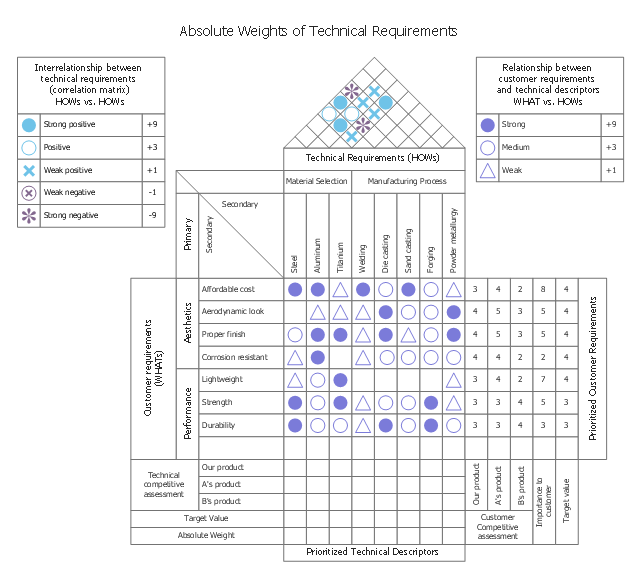
This house of quality sample illustrates prioritized technical descriptors.
It was designed on the base of the figure 3-7 in Lecture "How QFD helps in product quality improvement?" from the website of National Programme on Technology Enhanced
Learning (NPTEL), India. [nptel.ac.in/ courses/ 110101010/ downloads/ mod3/ Module%20 III-Lec1.pdf]
Distributed under Creative Commons Attribution-ShareAlike 4.0 International (CC BY-SA 4.0) [creativecommons.org/ licenses/ by-sa/ 4.0/ ]
"The technical competitive assessment makes up a block of rows corresponding to each technical descriptor in the house of quality beneath the relationship matrix. After respective technical factors have been established, the products are evaluated for each technical factor that addresses VOC.
Similar to the customer competitive assessment, the data recorded are in a scale of 1 through 5, to indicate a rating, 1 for worst and 5 for best. The technical competitive assessment is often useful in uncovering gaps in engineering judgment.
Importance ratings represent the relative importance of customer requirement in terms of each other.
The target-value of column can be on the same scale as the customer competitive assessment (1 for worst, 5 for best can be used). This column is where the QFD team decides whether they want to keep their product unchanged, improve the product, or make the product better than the competitor.
The prioritized technical descriptors make up a block of rows corresponding to the technical descriptor in the house of quality below the technical competitive assessment as shown in Figure 3-7. These prioritized technical descriptors contain target value and absolute weights." [nptel.ac.in/ courses/ 110101010/ modules/ module3/ lec1/ 1.9.html]
The HOQ example "House of Quality - prioritized technical descriptors" was designed using ConceptDraw PRO software extended with House of Quality solution from Quality area of ConceptDraw PRO Solution Park.
It was designed on the base of the figure 3-7 in Lecture "How QFD helps in product quality improvement?" from the website of National Programme on Technology Enhanced
Learning (NPTEL), India. [nptel.ac.in/ courses/ 110101010/ downloads/ mod3/ Module%20 III-Lec1.pdf]
Distributed under Creative Commons Attribution-ShareAlike 4.0 International (CC BY-SA 4.0) [creativecommons.org/ licenses/ by-sa/ 4.0/ ]
"The technical competitive assessment makes up a block of rows corresponding to each technical descriptor in the house of quality beneath the relationship matrix. After respective technical factors have been established, the products are evaluated for each technical factor that addresses VOC.
Similar to the customer competitive assessment, the data recorded are in a scale of 1 through 5, to indicate a rating, 1 for worst and 5 for best. The technical competitive assessment is often useful in uncovering gaps in engineering judgment.
Importance ratings represent the relative importance of customer requirement in terms of each other.
The target-value of column can be on the same scale as the customer competitive assessment (1 for worst, 5 for best can be used). This column is where the QFD team decides whether they want to keep their product unchanged, improve the product, or make the product better than the competitor.
The prioritized technical descriptors make up a block of rows corresponding to the technical descriptor in the house of quality below the technical competitive assessment as shown in Figure 3-7. These prioritized technical descriptors contain target value and absolute weights." [nptel.ac.in/ courses/ 110101010/ modules/ module3/ lec1/ 1.9.html]
The HOQ example "House of Quality - prioritized technical descriptors" was designed using ConceptDraw PRO software extended with House of Quality solution from Quality area of ConceptDraw PRO Solution Park.
HOQ of a handlebar stem in a bicycle
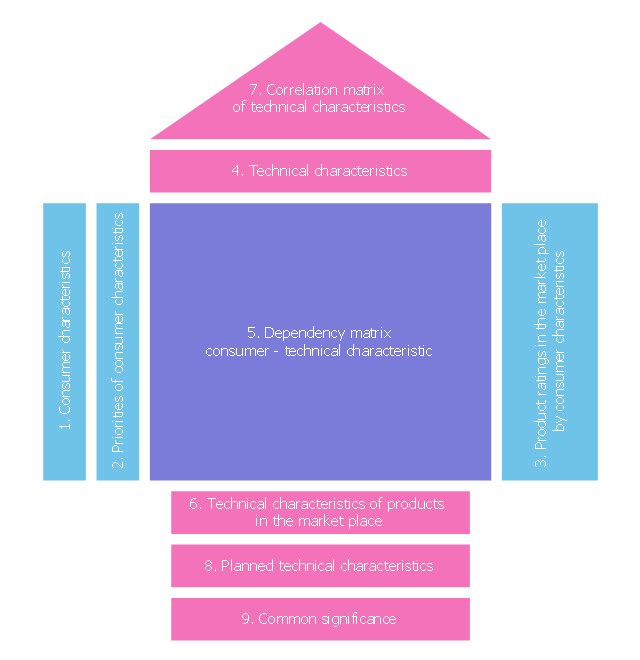
This house of quality matrix sample was designed on the base of the Wikimedia Commons file: Схема дома качества.jpg.
[ru.wikipedia.org/ wiki/ Файл:Схема_ дома_ качества.jpg ]
"The output of the house of quality is generally a matrix with customer desires on one dimension and correlated nonfunctional requirements on the other dimension. The cells of matrix table are filled with the weights assigned to the stakeholder characteristics where those characteristics are affected by the system parameters across the top of the matrix. At the bottom of the matrix, the column is summed, which allows for the system characteristics to be weighted according to the stakeholder characteristics. System parameters not correlated to stakeholder characteristics may be unnecessary to the system design and are identified by empty matrix columns, while stakeholder characteristics (identified by empty rows) not correlated to system parameters indicate "characteristics not address by the design parameters". System parameters and stakeholder characteristics with weak correlations potentially indicate missing information, while matrices with "too many correlations" indicate that the stakeholder needs may need to be refined." [Quality function deployment. Wikipedia]
The HOQ example "House of quality scheme" was designed using ConceptDraw PRO software extended with House of Quality solution from Quality area of ConceptDraw PRO Solution Park.
[ru.wikipedia.org/ wiki/ Файл:Схема_ дома_ качества.jpg ]
"The output of the house of quality is generally a matrix with customer desires on one dimension and correlated nonfunctional requirements on the other dimension. The cells of matrix table are filled with the weights assigned to the stakeholder characteristics where those characteristics are affected by the system parameters across the top of the matrix. At the bottom of the matrix, the column is summed, which allows for the system characteristics to be weighted according to the stakeholder characteristics. System parameters not correlated to stakeholder characteristics may be unnecessary to the system design and are identified by empty matrix columns, while stakeholder characteristics (identified by empty rows) not correlated to system parameters indicate "characteristics not address by the design parameters". System parameters and stakeholder characteristics with weak correlations potentially indicate missing information, while matrices with "too many correlations" indicate that the stakeholder needs may need to be refined." [Quality function deployment. Wikipedia]
The HOQ example "House of quality scheme" was designed using ConceptDraw PRO software extended with House of Quality solution from Quality area of ConceptDraw PRO Solution Park.
HOQ matrix
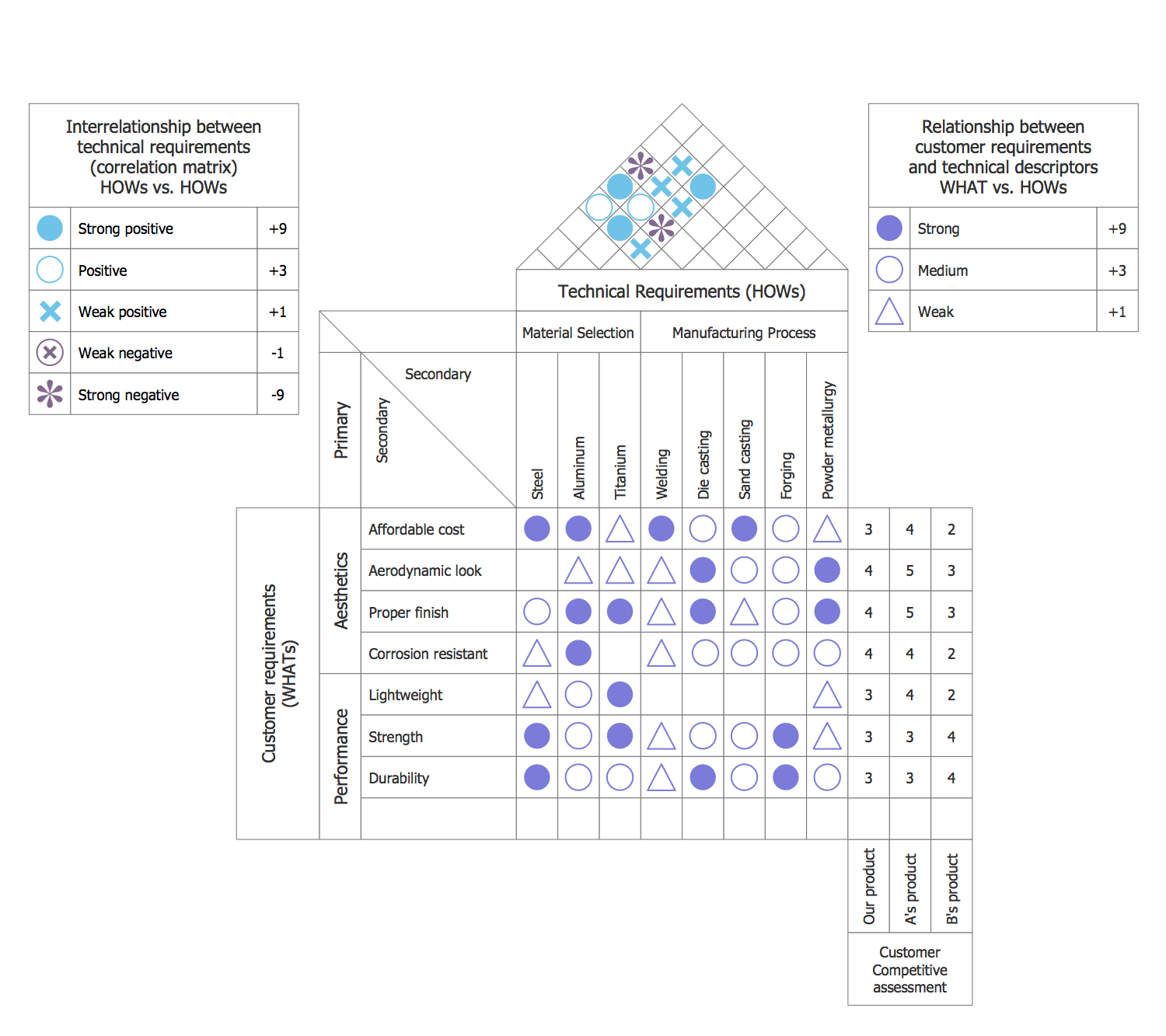
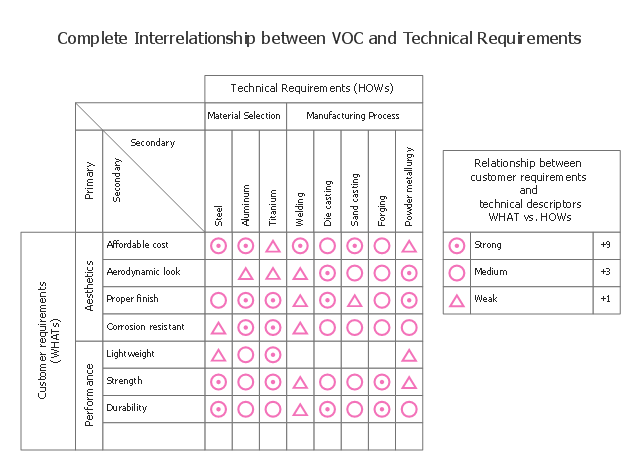
This house of quality sample illustrates interrelationship matrix.
It was designed on the base of the figure 3-4 in Lecture "How QFD helps in product quality improvement?" from the website of National Programme on Technology Enhanced
Learning (NPTEL), India. [nptel.ac.in/ courses/ 110101010/ downloads/ mod3/ Module%20 III-Lec1.pdf]
Distributed under Creative Commons Attribution-ShareAlike 4.0 International (CC BY-SA 4.0) [creativecommons.org/ licenses/ by-sa/ 4.0/ ]
"The next step in building a house of quality is to compare the VOC with technical characteristics and determine their interrelationships. In this context, engineering knowledge about the product and historic evidence/ data can provide useful information. Common practice is to use symbols to represent the nature of relationship between customer requirements and technical descriptors. Symbols used are:
- A solid circle represents a strong relationship (scored as +9).
- A single circle represents a medium relationship. (scored as +3).
- A triangle represents a weak relationship (scored as +1).
- The box is left blank if there is no relationship between VOC and technical characteristics.
Figure 3-4 provides the interrelationship matrix with type of relationships. Any cell that is empty implies no or insignificant relationship." [nptel.ac.in/ courses/ 110101010/ modules/ module3/ lec1/ 1.6.html]
The HOQ example "House of Quality - interrelationship matrix" was designed using ConceptDraw PRO software extended with House of Quality solution from Quality area of ConceptDraw PRO Solution Park.
It was designed on the base of the figure 3-4 in Lecture "How QFD helps in product quality improvement?" from the website of National Programme on Technology Enhanced
Learning (NPTEL), India. [nptel.ac.in/ courses/ 110101010/ downloads/ mod3/ Module%20 III-Lec1.pdf]
Distributed under Creative Commons Attribution-ShareAlike 4.0 International (CC BY-SA 4.0) [creativecommons.org/ licenses/ by-sa/ 4.0/ ]
"The next step in building a house of quality is to compare the VOC with technical characteristics and determine their interrelationships. In this context, engineering knowledge about the product and historic evidence/ data can provide useful information. Common practice is to use symbols to represent the nature of relationship between customer requirements and technical descriptors. Symbols used are:
- A solid circle represents a strong relationship (scored as +9).
- A single circle represents a medium relationship. (scored as +3).
- A triangle represents a weak relationship (scored as +1).
- The box is left blank if there is no relationship between VOC and technical characteristics.
Figure 3-4 provides the interrelationship matrix with type of relationships. Any cell that is empty implies no or insignificant relationship." [nptel.ac.in/ courses/ 110101010/ modules/ module3/ lec1/ 1.6.html]
The HOQ example "House of Quality - interrelationship matrix" was designed using ConceptDraw PRO software extended with House of Quality solution from Quality area of ConceptDraw PRO Solution Park.
HOQ of a handlebar stem in a bicycle
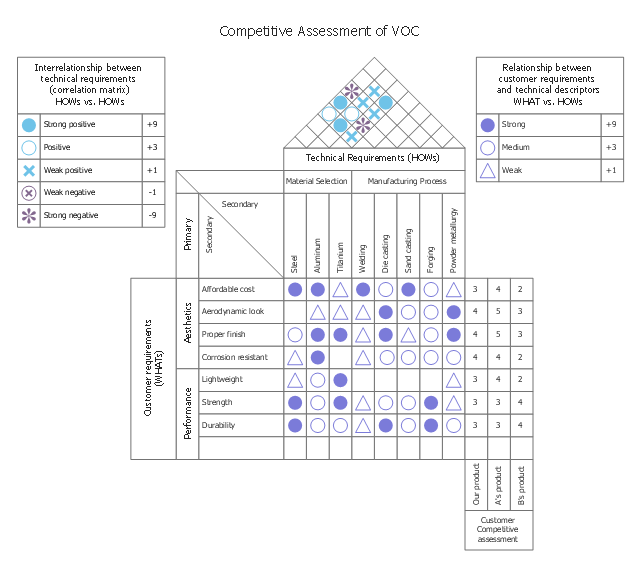
This house of quality sample illustrates competative assessment of voice of the customer (VOC).
It was designed on the base of the figure 3-6 in Lecture "How QFD helps in product quality improvement?" from the website of National Programme on Technology Enhanced
Learning (NPTEL), India. [nptel.ac.in/ courses/ 110101010/ downloads/ mod3/ Module%20 III-Lec1.pdf]
Distributed under Creative Commons Attribution-ShareAlike 4.0 International (CC BY-SA 4.0) [creativecommons.org/ licenses/ by-sa/ 4.0/ ]
"The customer’s competitive assessment (Figure 3-6) is a pair of table (or graph) that depicts how competitive products compare with current organization product status on specific VOC. The customer competitive assessment is the block of columns corresponding to each customer requirement in the house of quality on the right side of the relationship matrix, The numbers 1 through 5 are listed in the competitive evaluation column to indicate a rating of 1 for worst and 5 for best. The customer competitive assessment is a good way to determine if the customer voice has been met (as compared to best competitor) and identify areas to improvement for future design." [nptel.ac.in/ courses/ 110101010/ modules/ module3/ lec1/ 1.8.html]
The HOQ example "House of Quality - customer’s competitive assessment" was designed using ConceptDraw PRO software extended with House of Quality solution from Quality area of ConceptDraw PRO Solution Park.
It was designed on the base of the figure 3-6 in Lecture "How QFD helps in product quality improvement?" from the website of National Programme on Technology Enhanced
Learning (NPTEL), India. [nptel.ac.in/ courses/ 110101010/ downloads/ mod3/ Module%20 III-Lec1.pdf]
Distributed under Creative Commons Attribution-ShareAlike 4.0 International (CC BY-SA 4.0) [creativecommons.org/ licenses/ by-sa/ 4.0/ ]
"The customer’s competitive assessment (Figure 3-6) is a pair of table (or graph) that depicts how competitive products compare with current organization product status on specific VOC. The customer competitive assessment is the block of columns corresponding to each customer requirement in the house of quality on the right side of the relationship matrix, The numbers 1 through 5 are listed in the competitive evaluation column to indicate a rating of 1 for worst and 5 for best. The customer competitive assessment is a good way to determine if the customer voice has been met (as compared to best competitor) and identify areas to improvement for future design." [nptel.ac.in/ courses/ 110101010/ modules/ module3/ lec1/ 1.8.html]
The HOQ example "House of Quality - customer’s competitive assessment" was designed using ConceptDraw PRO software extended with House of Quality solution from Quality area of ConceptDraw PRO Solution Park.
HOQ of a handlebar stem in a bicycle
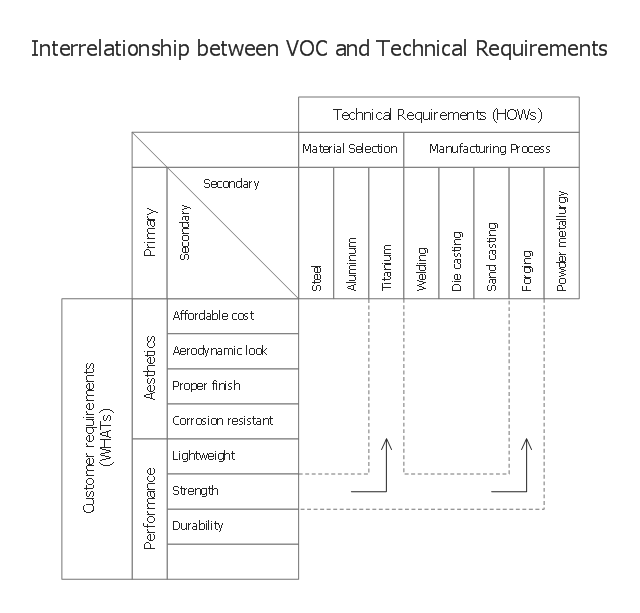
This house of quality sample illustrates VOC vs. technical requirements.
It was designed on the base of the figure 3-3 in Lecture "How QFD helps in product quality improvement?" from the website of National Programme on Technology Enhanced
Learning (NPTEL), India. [nptel.ac.in/ courses/ 110101010/ downloads/ mod3/ Module%20 III-Lec1.pdf]
Distributed under Creative Commons Attribution-ShareAlike 4.0 International (CC BY-SA 4.0) [creativecommons.org/ licenses/ by-sa/ 4.0/ ]
"As the customer needs and expectations are expressed in terms of customer requirements, the QFD team needs to come up with engineering characteristics (HOW’s) that will affect one or more of the customer requirements. Each engineering characteristic must directly affect a customer perception (VOC) and be expressed in measurable terms.
Implementation of the customer requirements in design is difficult until they are translated into counterpart technical characteristics. Counterpart technical characteristics are an expression of the voice of the customer in technical language and specifications. For example, a customer requirement for an automobile might be a smooth ride. This is rather an abstract statement, which is important from the point of view of selling an automobile. Technical characteristics for a smooth ride can be appropriate dampening, anti-roll, and stability requirements. These are the primary technical descriptors or characteristics. Engineering knowledge and brainstorming among engineering staff’s is a suggested method for determining technical characteristics. Figure 3-3 shows the different technical requirements which can address all VOC for the bike stem design." [nptel.ac.in/ courses/ 110101010/ modules/ module3/ lec1/ 1.5.html]
The HOQ example "House of Quality - VOC vs. Technical Requirements" was designed using ConceptDraw PRO software extended with House of Quality solution from Quality area of ConceptDraw PRO Solution Park.
It was designed on the base of the figure 3-3 in Lecture "How QFD helps in product quality improvement?" from the website of National Programme on Technology Enhanced
Learning (NPTEL), India. [nptel.ac.in/ courses/ 110101010/ downloads/ mod3/ Module%20 III-Lec1.pdf]
Distributed under Creative Commons Attribution-ShareAlike 4.0 International (CC BY-SA 4.0) [creativecommons.org/ licenses/ by-sa/ 4.0/ ]
"As the customer needs and expectations are expressed in terms of customer requirements, the QFD team needs to come up with engineering characteristics (HOW’s) that will affect one or more of the customer requirements. Each engineering characteristic must directly affect a customer perception (VOC) and be expressed in measurable terms.
Implementation of the customer requirements in design is difficult until they are translated into counterpart technical characteristics. Counterpart technical characteristics are an expression of the voice of the customer in technical language and specifications. For example, a customer requirement for an automobile might be a smooth ride. This is rather an abstract statement, which is important from the point of view of selling an automobile. Technical characteristics for a smooth ride can be appropriate dampening, anti-roll, and stability requirements. These are the primary technical descriptors or characteristics. Engineering knowledge and brainstorming among engineering staff’s is a suggested method for determining technical characteristics. Figure 3-3 shows the different technical requirements which can address all VOC for the bike stem design." [nptel.ac.in/ courses/ 110101010/ modules/ module3/ lec1/ 1.5.html]
The HOQ example "House of Quality - VOC vs. Technical Requirements" was designed using ConceptDraw PRO software extended with House of Quality solution from Quality area of ConceptDraw PRO Solution Park.
HOQ of a handlebar stem in a bicycle
Product Planning
This house of quality sample illustrates correlation matrix.
It was designed on the base of the figure 3-5 in Lecture "How QFD helps in product quality improvement?" from the website of National Programme on Technology Enhanced Learning (NPTEL), India. [nptel.ac.in/ courses/ 110101010/ downloads/ mod3/ Module%20 III-Lec1.pdf]
Distributed under Creative Commons Attribution-ShareAlike 4.0 International (CC BY-SA 4.0) [creativecommons.org/ licenses/ by-sa/ 4.0/ ]
"After drafting the relationship matrix, it is evaluated for any empty row or column. An empty row indicates that a customer voice is not being addressed by any technical descriptors. Thus, the customer expectation is not being met. Any blank column indicates that the technical requirement is unnecessary, as it does not address any VOC.
The roof of the house of quality, expressed as correlation matrix, is used to identify any interrelationships between the technical descriptors (Figure 3-5). Symbols are used to describe the strength of the interrelationships. Symbols generally preferred are:
- A ‘solid circle’ represents a strong positive relationship.
- A ‘circle’ represents a positive relationship.
- An ‘X’ represents a negative relationship.
- An ‘asterisk’ represents a strong negative relationship." [nptel.ac.in/ courses/ 110101010/ modules/ module3/ lec1/ 1.7.html]
The HOQ example "House of Quality - correlation matrix" was designed using ConceptDraw PRO software extended with House of Quality solution from Quality area of ConceptDraw PRO Solution Park.
It was designed on the base of the figure 3-5 in Lecture "How QFD helps in product quality improvement?" from the website of National Programme on Technology Enhanced Learning (NPTEL), India. [nptel.ac.in/ courses/ 110101010/ downloads/ mod3/ Module%20 III-Lec1.pdf]
Distributed under Creative Commons Attribution-ShareAlike 4.0 International (CC BY-SA 4.0) [creativecommons.org/ licenses/ by-sa/ 4.0/ ]
"After drafting the relationship matrix, it is evaluated for any empty row or column. An empty row indicates that a customer voice is not being addressed by any technical descriptors. Thus, the customer expectation is not being met. Any blank column indicates that the technical requirement is unnecessary, as it does not address any VOC.
The roof of the house of quality, expressed as correlation matrix, is used to identify any interrelationships between the technical descriptors (Figure 3-5). Symbols are used to describe the strength of the interrelationships. Symbols generally preferred are:
- A ‘solid circle’ represents a strong positive relationship.
- A ‘circle’ represents a positive relationship.
- An ‘X’ represents a negative relationship.
- An ‘asterisk’ represents a strong negative relationship." [nptel.ac.in/ courses/ 110101010/ modules/ module3/ lec1/ 1.7.html]
The HOQ example "House of Quality - correlation matrix" was designed using ConceptDraw PRO software extended with House of Quality solution from Quality area of ConceptDraw PRO Solution Park.
HOQ of a handlebar stem in a bicycle
- How to Create a House of Quality Diagram | House of Quality ...
- How to Create a House of Quality Diagram | House of quality 9 step ...
- House of Quality Matrix Software | Total Quality Management ...
- House of Quality | House of Quality Matrix Software | How to Create ...
- How to Create a House of Quality Diagram | House of Quality Matrix ...
- House of Quality | House of Quality Matrix Software | Seven Basic ...
- House of Quality | QFD house of quality | How to Create a House of ...
- House of Quality - interrelationship matrix | PROBLEM ANALYSIS ...
- House of Quality | Interactive Voice Response Diagrams | Quality ...
- QFD house of quality
- House of quality diagram
- Building the House of Quality
- House of Quality - prioritized technical descriptors
- House of quality 9 step - Template
- Quality function deployment chart - Handheld projector | QFD matrix ...
- House of Quality | Customer types matrix | Product Planning ...
- How to Create a House of Quality Diagram | Plumbing and Piping ...
- House of Quality - VOC vs. Technical Requirements


