ESG
Environmental, Social and Corporate Governance (ESG) is a complex set of standards for company behavior, business strategies, and sustainability. ESG is much broader than just maximizing company profits. It includes non-financial performance indicators that cover issues in three categories: environment, social aspects, and governance. In addition, ESG is a stakeholder-centric approach for businesses. It takes into account the interests of all stakeholders: employees, investors, society, and the environment.
ESG helps to reduce risks and increase profitability, that is, the ratio of income from an investment to its starting cost. This helps stakeholders to understand how the organization manages the risks and opportunities associated with sustainability. ESG analysis encourages continuous improvement, and in general, ESG-focused companies are more resilient and less risky. Today, the focus is on such organizations and investments in them are growing.
ESG is a progressive modern method currently used by most investment funds. Because investors seek to fund the companies that are responsible for the environment, society, and internal governance. ESG criteria are a kind of guarantee that a company is socially responsible, uses transparent accounting methods, and is accountable to shareholders. Unsustainable companies with outdated practices and which activities have harmful effects on the environment or society aren't currently interesting to investors.
Adherence to ESG principles ensures companies higher profits, competitiveness in the market, high dividend payments and returns, and decrease risks. ESG includes ways to maximize stakeholder well-being, makes transparent the company policy, and helps evaluate how a company manages the risks. The choice of sustainable responsible companies working according to ESG ensures the minimization of risks for investors, helps them anticipate critical situations and avoid suspicious investments.
ESG includes three groups of criteria:
Environmental criteria are related to protecting the environment from pollution of water, air, soil, and resulting climate change. They consider how the company limits emissions of chemicals, greenhouse gases, and other harmful pollutants. The use of renewable energy is encouraged along with waste management, resource depletion control, deforestation, and saving biodiversity.
Social criteria consider the social relationships with employees, suppliers, customers, and the communities in which the company operates. They take into account respect for human rights and health, how the company manages relationships among employees and prevents conflicts, which are its workplace and safety policies, working conditions, and wages.
Governance criteria are focused on the company's government and decision-making. They take into account transparency of financial reporting, tax strategy, audit, anti-bribery and anti-corruption policies, and relationships with all shareholders, investors, and customers.
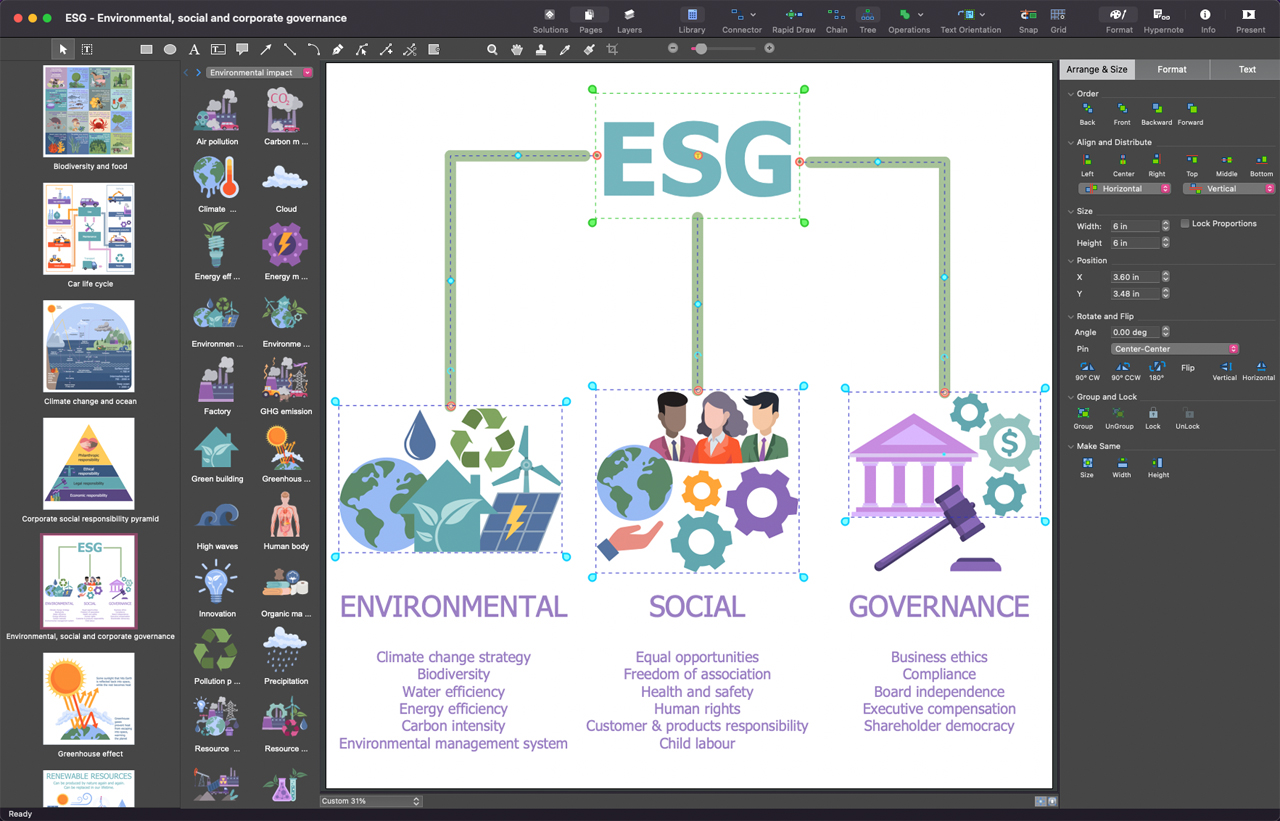
Example 1. ESG Infographics Design in ConceptDraw DIAGRAM
Environmental, Social and Corporate Governance solution helps to outline the ESG standards, factors, and key ESG criteria that align with business strategy, build and enhance ESG frameworks. Illustrate easily principles of sustainability, waste management, the importance of the use of renewable energy sources, and ways to avoid climate change, deforestation, and biodiversity loss. The creation of ESG infographics helps to provide better transparency and thorough reporting, show quantifiable business metrics, eliminate risks and gaps in the business to achieve growth.
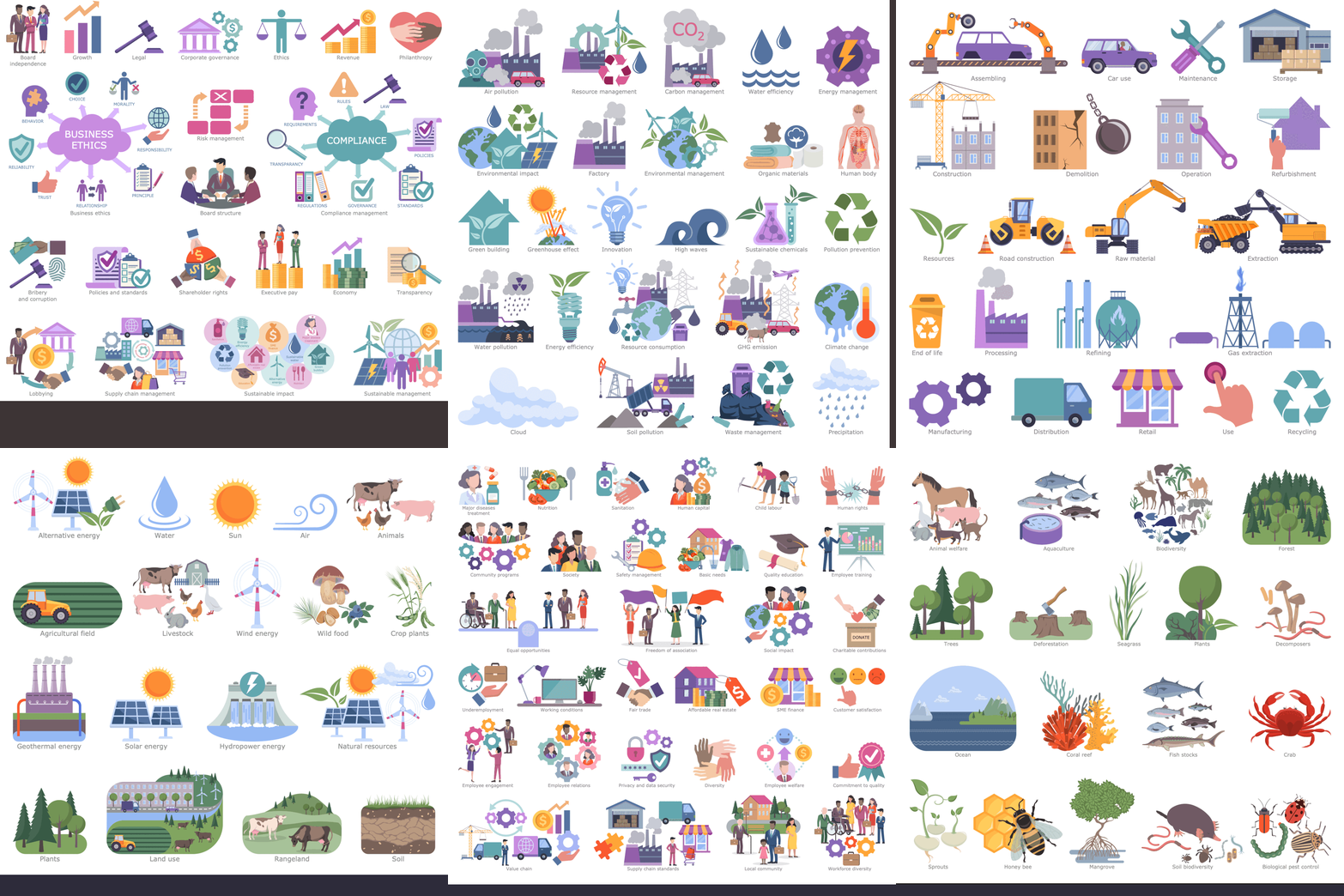
Example 2. ESG Solution Libraries Design Elements
Environmental, Social, and Corporate Governance solution offers 6 libraries of vector design elements of corporate governance, environmental and social impacts, biodiversity, renewable energy and resources, life cycle stage, and more to create ESG infographics, diagrams, and illustrations of any complexity without efforts. The ESG samples and examples included in the Environmental, Social, and Corporate Governance solution are illustrative and perfectly suit for using as templates for your own diagrams.
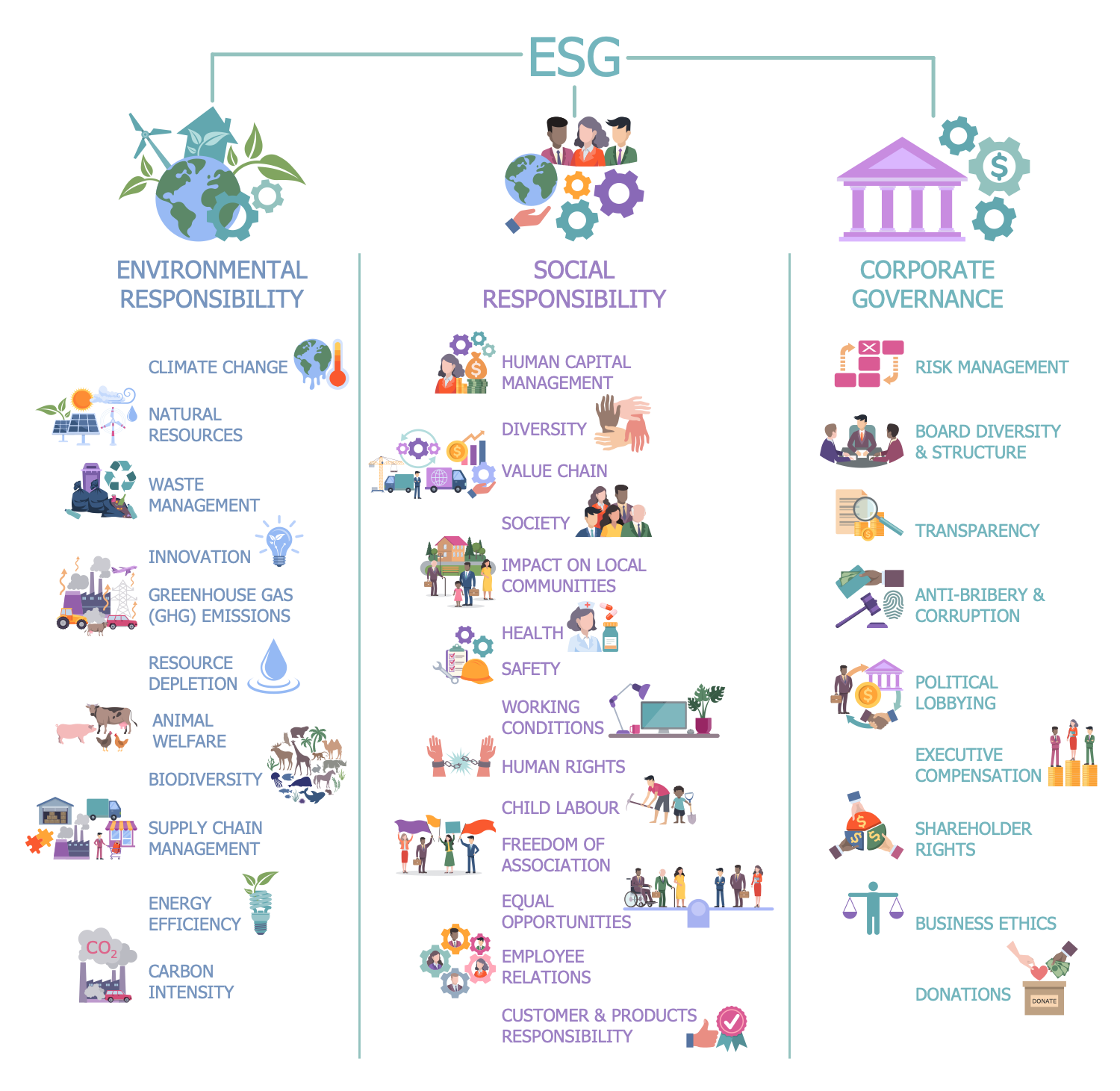
Example 3. ESG Infographics
The ESG infographic samples you see on this page were created in ConceptDraw DIAGRAM software using the drawing tools of the Environmental, Social, and Corporate Governance Solution. These examples successfully demonstrate the solution's capabilities and professional results you can achieve using it. An experienced user spent 5-10 minutes creating each of these samples.
Use the drawing tools of the Environmental, Social, and Corporate Governance solution to design your own ESG Infographics quick, easy, and effective.
All source documents are vector graphic documents. They are available for reviewing, modifying, or converting to a variety of formats (PDF file, MS PowerPoint, MS Visio, and many other graphic formats) from the ConceptDraw STORE. The Environmental, Social, and Corporate Governance Solution is available for ConceptDraw DIAGRAM users.
TEN RELATED HOW TO's:
ConceptDraw - feature-rich flowchart software allows you create professional looking flowcharts.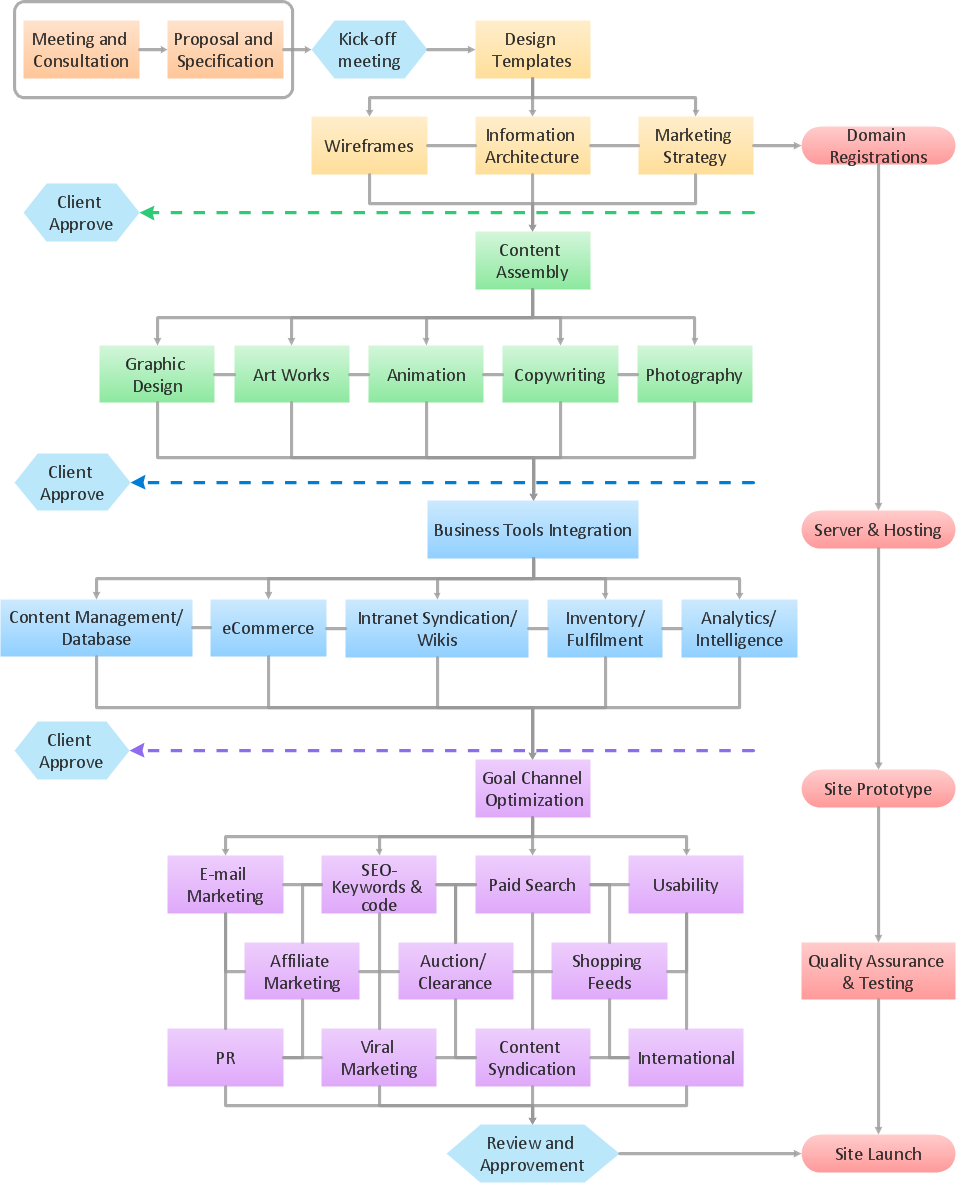
Picture: Best Program to Create a Flowchart
Related Solution:
Bar charts represent data in different categories or groups.
Create bar graphs for visual solving your scientific problems and data comparison using the ConceptDraw DIAGRAM diagramming and vector drawing software extended with the Bar Graphs Solution from the Graphs and Charts area of ConceptDraw Solition Park.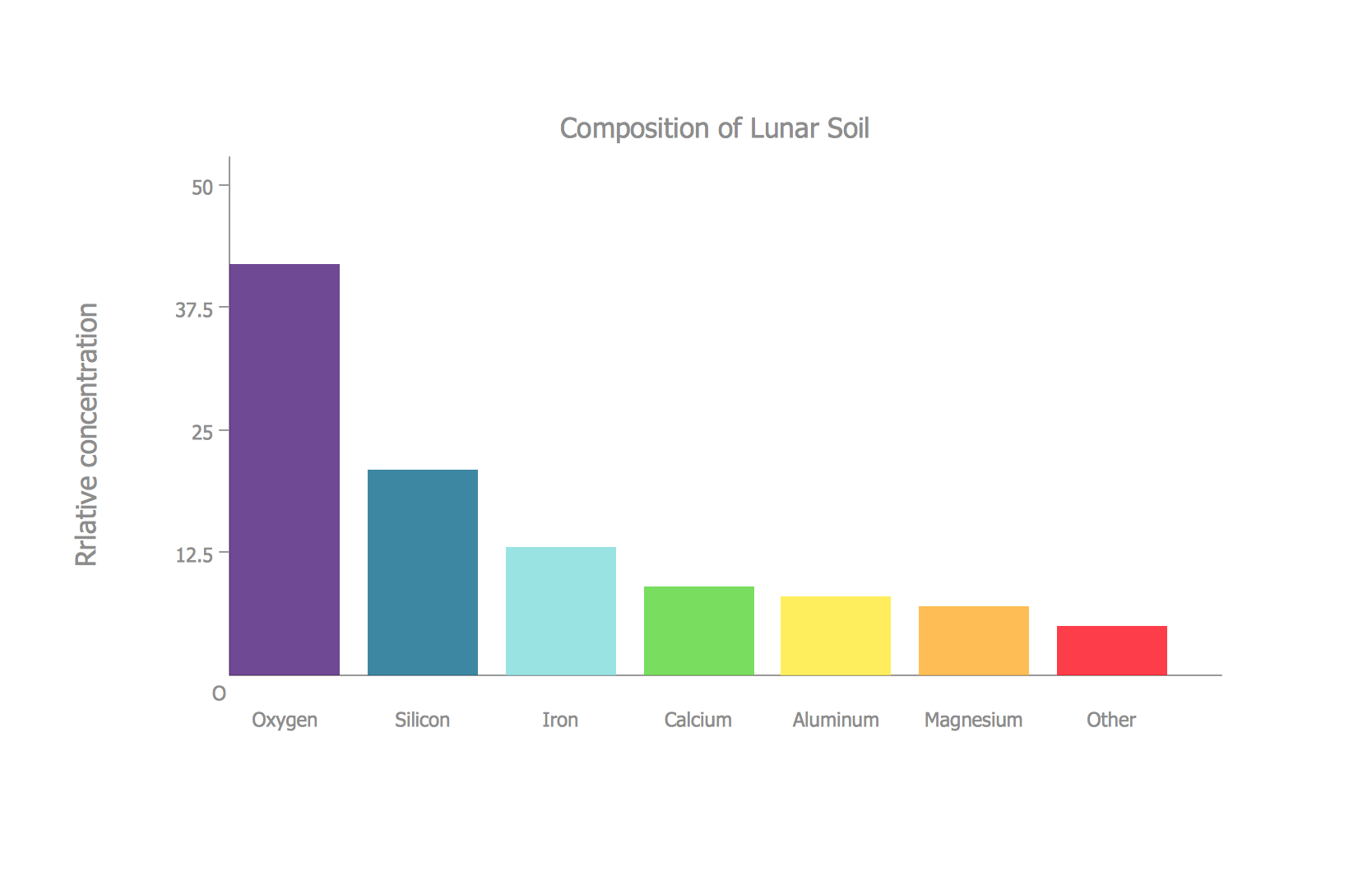
Picture: Bar Diagrams for Problem Solving.Create space science bar charts with Bar Graphs Solution
Related Solution:
Why do you need network visualizations? 🔸 Unlock the full potential of network visualization with our in-depth guide on using the ConceptDraw Network Visualization Tool. ✔️ Explore features, tips, and best practices to create stunning visual representations of your network architecture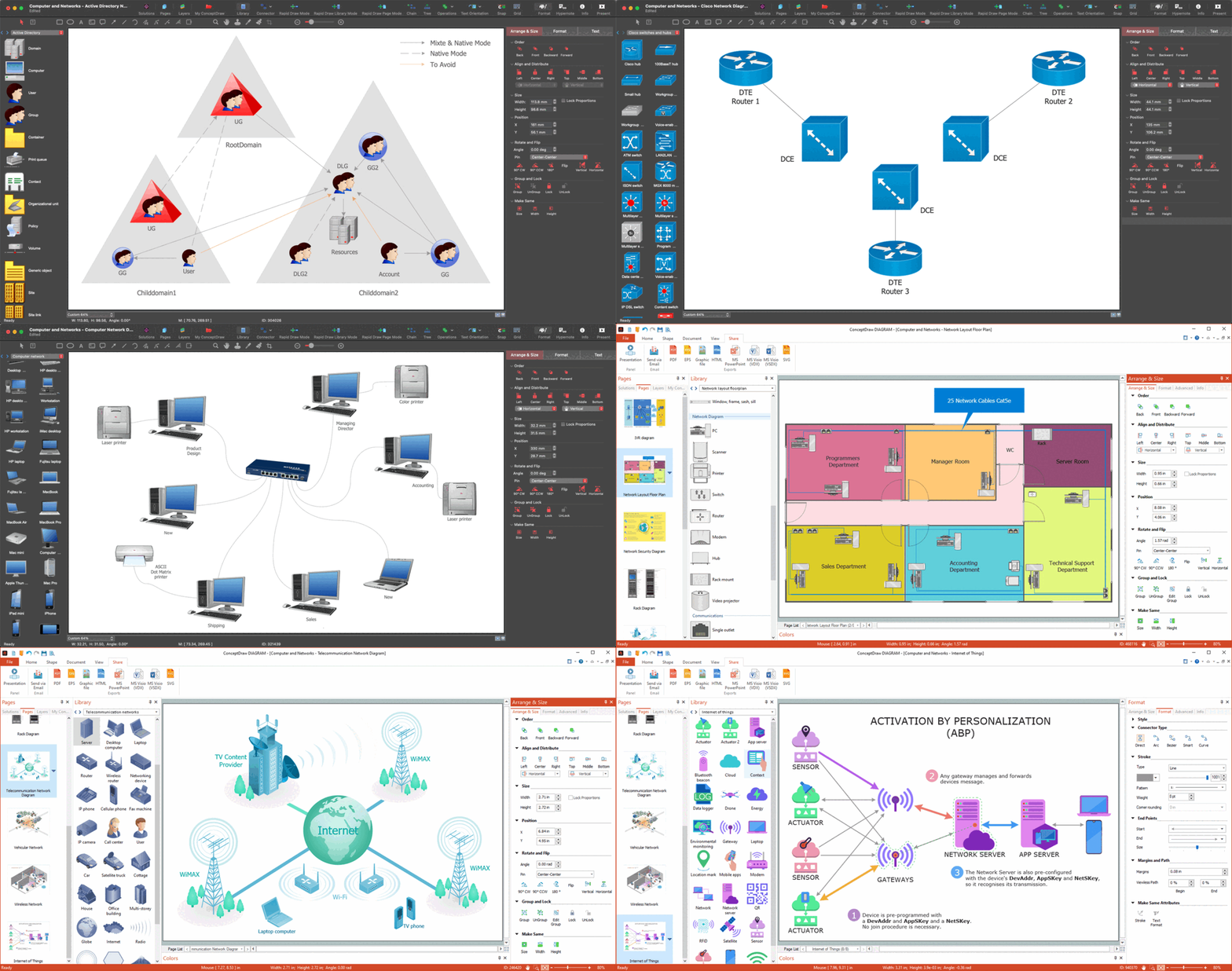
Picture:
Network Visualization Guide.
How to Use ConceptDraw Network Visualization Tool
Related Solutions:
Working with personnel might be difficult if you are not prepared enough. To explain your workers all the details of communication with customers, you can draw an order process flowchart which will describe every step of the process and answer all the questions that might appear. You can view a lot of business process mapping diagram examples here, in ConceptDraw Solution Park.
This business process flow chart is created to illustrate the sample work order process. Before an organization can make some work for a person, the customer work order request must be completed. It is needed for tracking and accountability objectives. We used this business process flowchart to show a certain tasks and actions assumed by an organization. This flowchart depicts the outside inputs that are needed to launch a process, and ways the organization delivers its outputs. This business process flowchart was created with a help of ConceptDraw Business Process Mapping solution.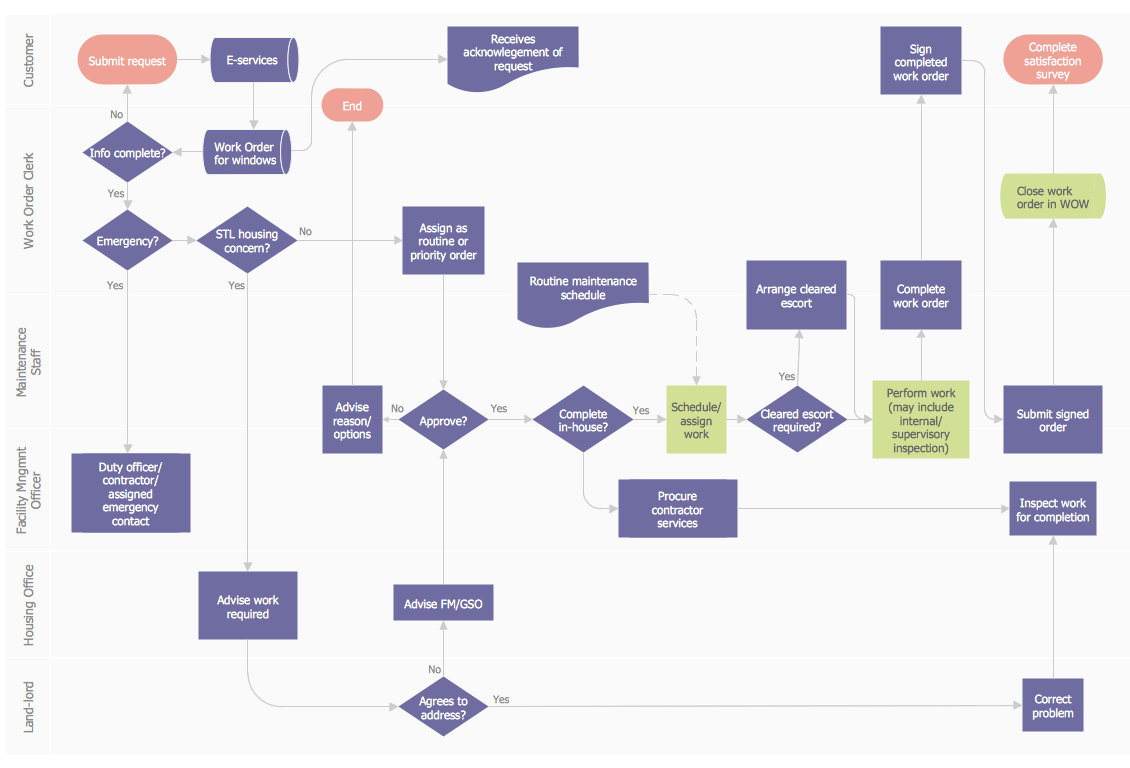
Picture: Work Order Process Flowchart. Business Process Mapping Examples
Related Solution:
Root Cause Analysis Tree Diagram. Use the Root Cause Diagram to perform visual root cause analysis. Root Cause Analysis Tree Diagram is constructed separately for each highly prioritized factor. The goal of this is to find the root causes for the factor and list possible corrective action.
ConceptDraw Office suite is a software for problem analysis.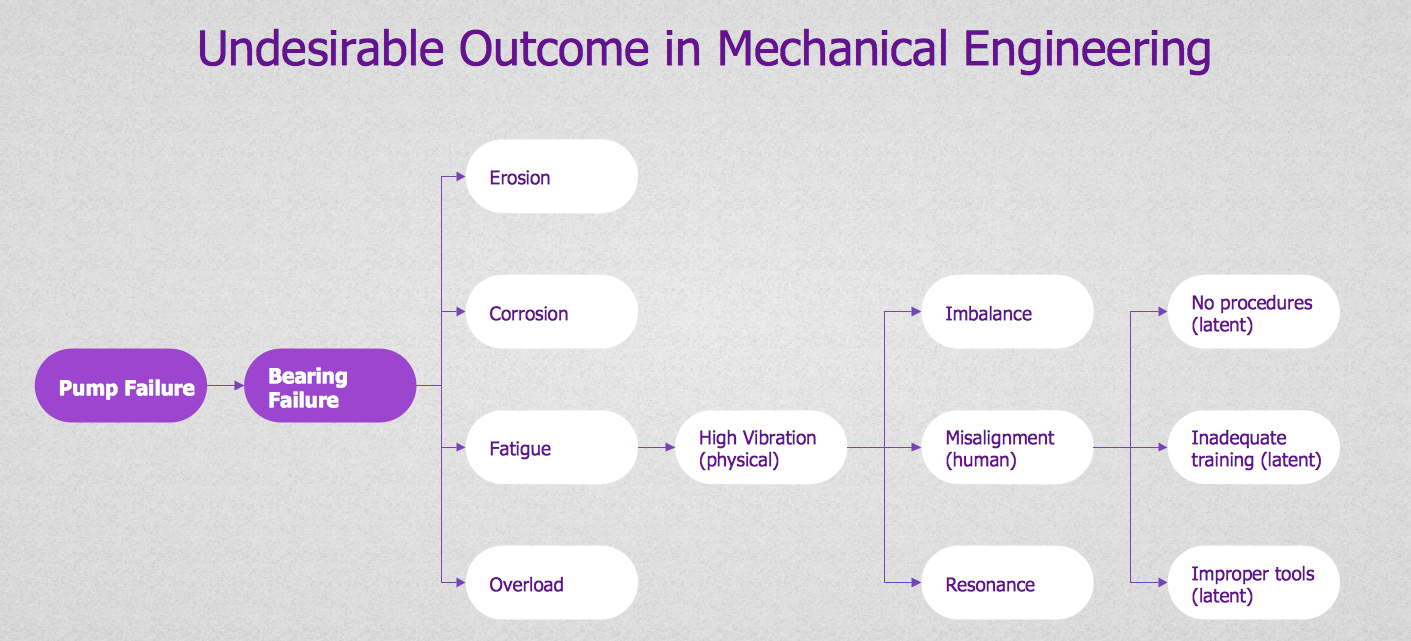
Picture: PROBLEM ANALYSIS. Root Cause Analysis Tree Diagram
Event-Driven Process chain Diagrams for improvement throughout an organisation. Best software for Process Flow Diagram. The Event-driven Process Chain (EPC) Diagrams allows managers to plan processes and resources.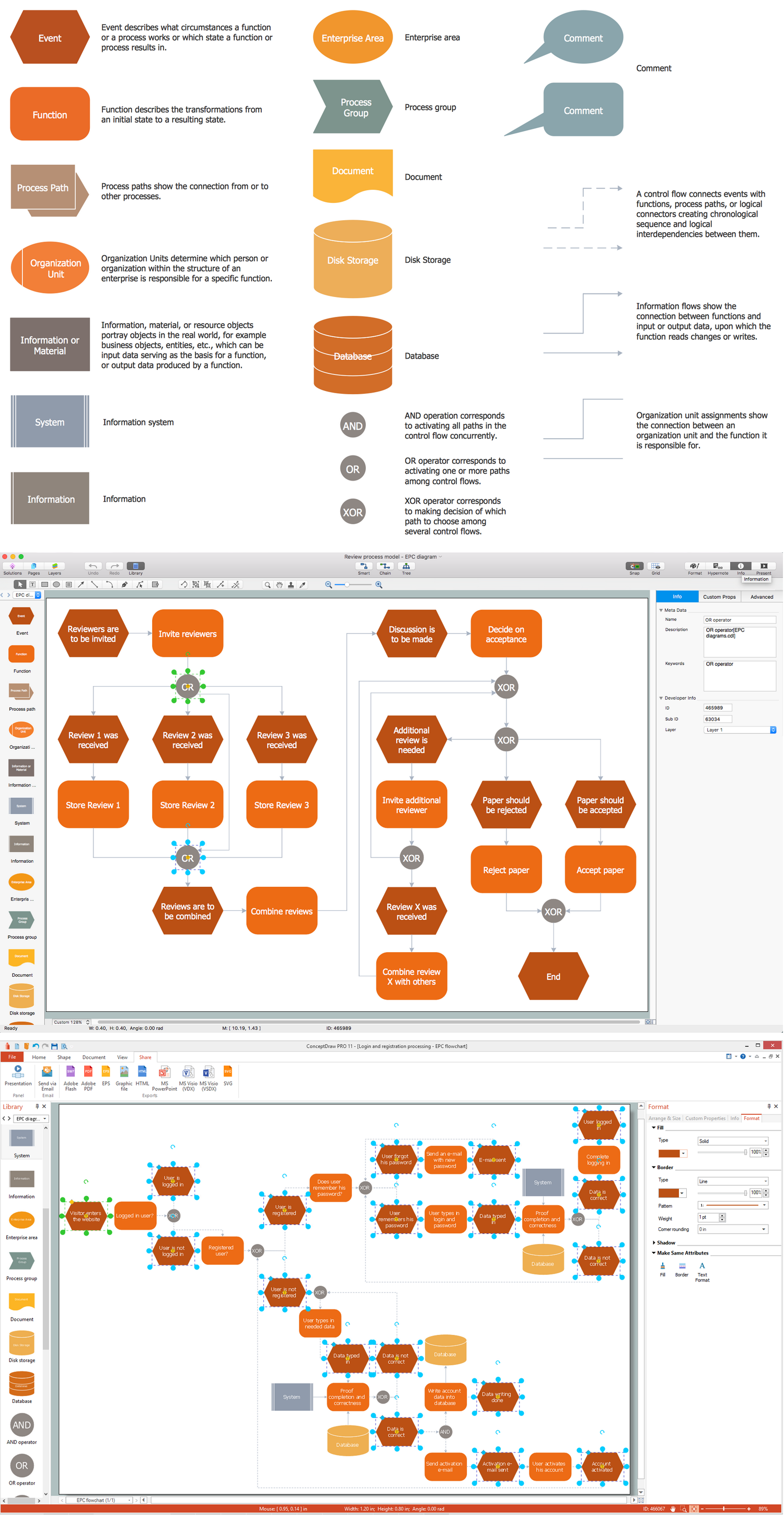
Picture: Business process Flow Chart — Event-Driven Process chain (EPC) diagrams
Related Solution:
While creating flowcharts and process flow diagrams, you should use special objects to define different statements, so anyone aware of flowcharts can get your scheme right. There is a short and an extended list of basic flowchart symbols and their meaning. Basic flowchart symbols include terminator objects, rectangles for describing steps of a process, diamonds representing appearing conditions and questions and parallelograms to show incoming data.
This diagram gives a general review of the standard symbols that are used when creating flowcharts and process flow diagrams. The practice of using a set of standard flowchart symbols was admitted in order to make flowcharts and other process flow diagrams created by any person properly understandable by other people. The flowchart symbols depict different kinds of actions and phases in a process. The sequence of the actions, and the relationships between them are shown by special lines and arrows. There are a large number of flowchart symbols. Which of them can be used in the particular diagram depends on its type. For instance, some symbols used in data flow diagrams usually are not used in the process flowcharts. Business process system use exactly these flowchart symbols.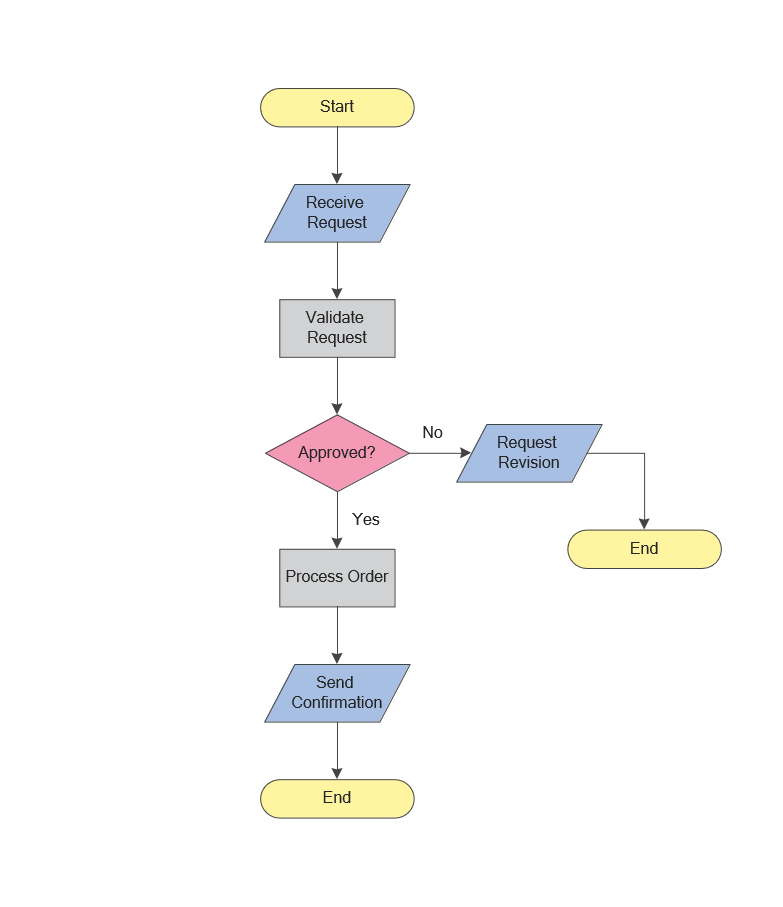
Picture: Flowchart Symbols: Meaning and Examples
Related Solution:
ConceptDraw DIAGRAM is ideal for software designers and software developers who need to draw Booch OOD Diagrams.
Picture: Booch OOD Diagram
Visual information is easier to perceive. You can teach even a child to make diagrams with a good flowchart example that would be interesting for it. Flowcharts can be fun, it’s not about business processes or programming algorithms.
This flowchart shows step by step process of manufacturing of Nixtamal The product which is obtained by processing maize with calcium hydroxide. We must assume that the Aztecs were very fond of this product, if the recipe of its production came to our times. This flow chart was designed using ConceptDraw DIAGRAM with its solution for designing flowcharts of various types, sizes and purposes. ConceptDraw Flowcharts solution consists from the library of flowchart symbols, containing the set vector objects. Also there are a lot of diverse templates and samples of flow charts.
Picture: Flowchart Examples and Templates
Related Solution:
This sample shows the Flowchart that displays the architecture of SQL Exception Translation.
This sample was created in ConceptDraw DIAGRAM diagramming and vector drawing software using the Flowcharts solution from the Diagrams area of ConceptDraw Solution Park.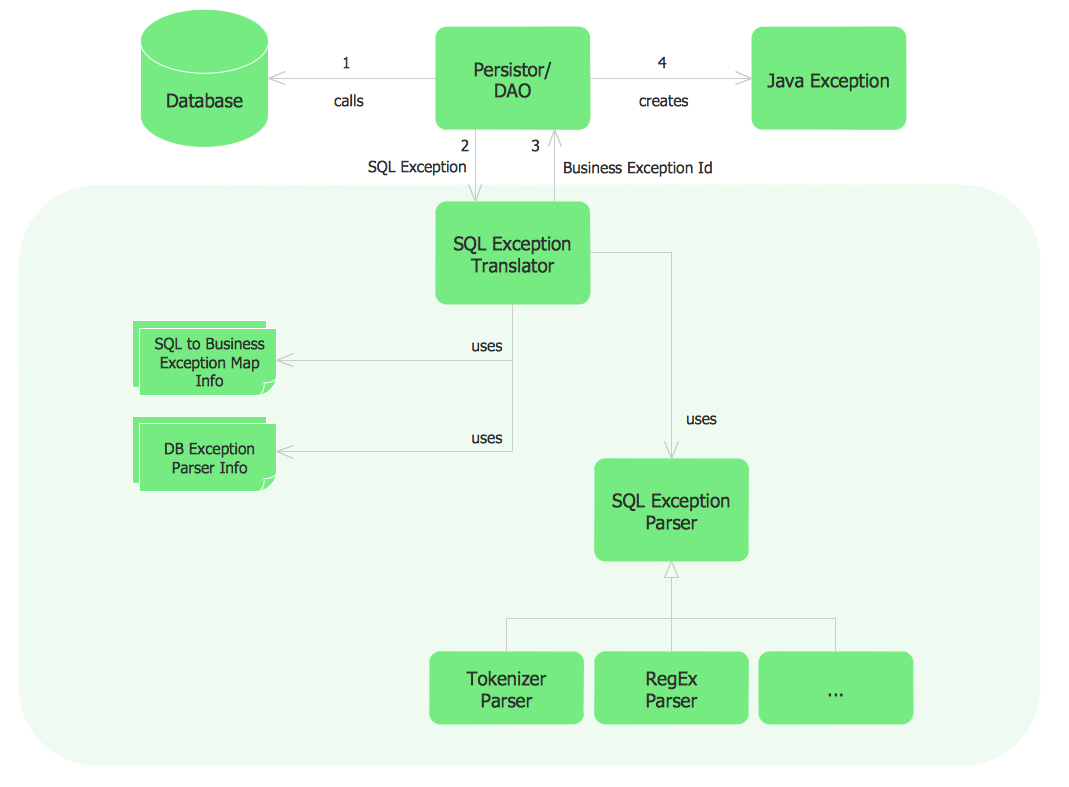
Picture: Sample Project Flowchart. Flowchart Examples
Related Solution:

