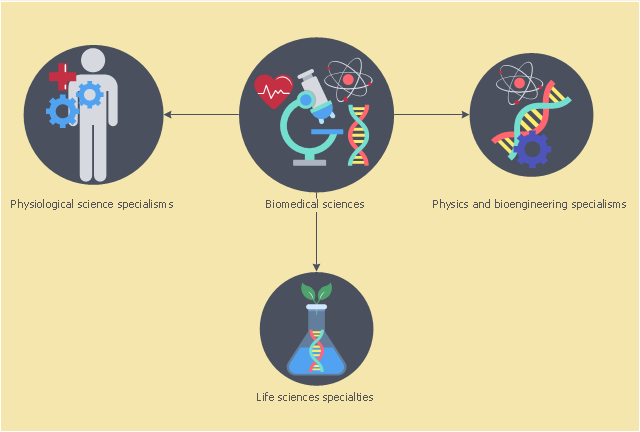
This healthcare infographic sample shows biomedical sciences.
"Biomedical sciences are a set of applied sciences applying portions of natural science or formal science, or both, to knowledge, interventions, or technology that are of use in healthcare or public health. Such disciplines as medical microbiology, clinical virology, clinical epidemiology, genetic epidemiology, and biomedical engineering are medical sciences. In explaining physiological mechanisms operating in pathological processes, however, pathophysiology can be regarded as basic science. ...
There are at least 45 different specialisms within healthcare science, which are traditionally grouped into three main divisions:
- specialisms involving life sciences,
- specialisms involving physiological science,
- specialisms involving medical physics or bioengineering" [Biomedical sciences. Wikipedia]
The healthcare infographic example "Biomedical sciences" was designed using ConceptDraw PRO software extended with Biomedicine solution from Health area of ConceptDraw Solution Park.
"Biomedical sciences are a set of applied sciences applying portions of natural science or formal science, or both, to knowledge, interventions, or technology that are of use in healthcare or public health. Such disciplines as medical microbiology, clinical virology, clinical epidemiology, genetic epidemiology, and biomedical engineering are medical sciences. In explaining physiological mechanisms operating in pathological processes, however, pathophysiology can be regarded as basic science. ...
There are at least 45 different specialisms within healthcare science, which are traditionally grouped into three main divisions:
- specialisms involving life sciences,
- specialisms involving physiological science,
- specialisms involving medical physics or bioengineering" [Biomedical sciences. Wikipedia]
The healthcare infographic example "Biomedical sciences" was designed using ConceptDraw PRO software extended with Biomedicine solution from Health area of ConceptDraw Solution Park.
Healthcare infographic
 Biomedicine
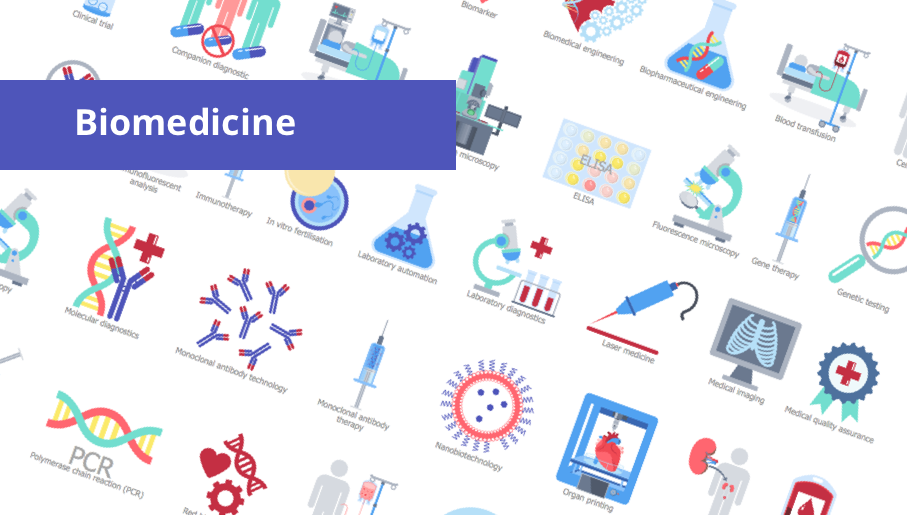
Biomedicine solution extends ConceptDraw DIAGRAM ector diagramming software with abundance of samples and libraries of vector biomedical icons, pictograms of biomedical sciences and biomedical technologies, the main purpose of which is to help biomedical doctors, biomedical researchers, scientific professionals, professors in biomedical science, technicians, lectors, students to describe visually and to illustrate new achievements and new technologies in biomedical science, results of experiments and tests at this field, to depict the history of biomedicine development, the stages and progress at this field, to plan future biomedicine technologies and to describe those that are now in development or on the stage of testing the biomedical technology by biomedical specialists, to design colorful and professionally looking illustrations, diagrams, presentation slides and infographics in fields of biomedicine, personalized medicine, regenerative medicine, molecular medicine, evidence-based medicine, reconstructive biomedicine, and preventive health care.
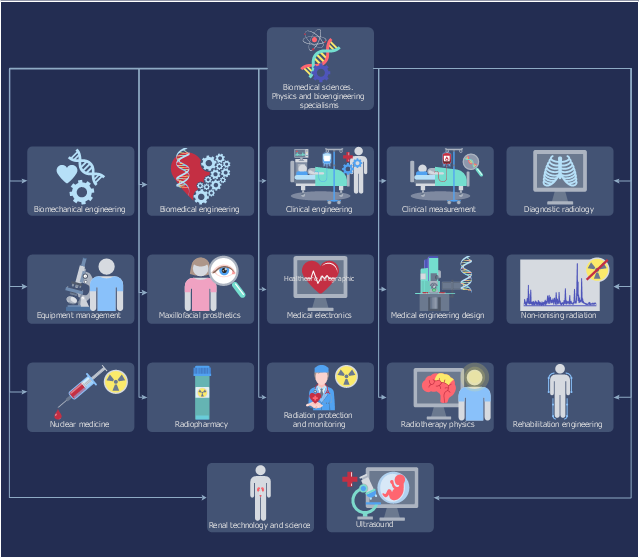
This healthcare infographic sample shows the medical physics and biological engineering specialties.
"Biomedical engineering (BME) is the application of engineering principles and design concepts to medicine and biology for healthcare purposes (e.g. diagnostic or therapeutic). This field seeks to close the gap between engineering and medicine, combining the design and problem solving skills of engineering with medical biological sciences to advance health care treatment, including diagnosis, monitoring, and therapy. Biomedical engineering has only recently emerged as its own study, as compared to many other engineering fields. Such an evolution is common as a new field transitions from being an interdisciplinary specialization among already-established fields, to being considered a field in itself. Much of the work in biomedical engineering consists of research and development, spanning a broad array of subfields..." [Biomedical engineering. Wikipedia]
The healthcare infographic example "Biomedical sciences. Physics and bioengineering" was designed using ConceptDraw PRO software extended with Biomedicine solution from Health area of ConceptDraw Solution Park.
"Biomedical engineering (BME) is the application of engineering principles and design concepts to medicine and biology for healthcare purposes (e.g. diagnostic or therapeutic). This field seeks to close the gap between engineering and medicine, combining the design and problem solving skills of engineering with medical biological sciences to advance health care treatment, including diagnosis, monitoring, and therapy. Biomedical engineering has only recently emerged as its own study, as compared to many other engineering fields. Such an evolution is common as a new field transitions from being an interdisciplinary specialization among already-established fields, to being considered a field in itself. Much of the work in biomedical engineering consists of research and development, spanning a broad array of subfields..." [Biomedical engineering. Wikipedia]
The healthcare infographic example "Biomedical sciences. Physics and bioengineering" was designed using ConceptDraw PRO software extended with Biomedicine solution from Health area of ConceptDraw Solution Park.
Healthcare infographic
Used Solutions
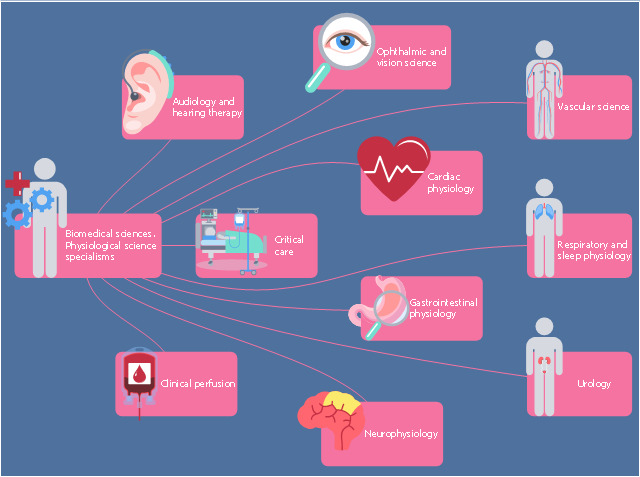
This healthcare infographic sample shows the physiological science specialties.
"Physiological science specialisms:
- Audiology and hearing therapy,
- Autonomic neurovascular function,
- Cardiac physiology,
- Clinical perfusion,
- Critical care science,
- Gastrointestinal physiology,
- Neurophysiology,
- Ophthalmic and vision science,
- Respiratory and sleep physiology,
- Urology,
- Vascular science" [Biomedical sciences. Wikipedia]
The healthcare infographic example "Biomedical sciences. Physiological science" was designed using ConceptDraw PRO software extended with Biomedicine solution from Health area of ConceptDraw Solution Park.
"Physiological science specialisms:
- Audiology and hearing therapy,
- Autonomic neurovascular function,
- Cardiac physiology,
- Clinical perfusion,
- Critical care science,
- Gastrointestinal physiology,
- Neurophysiology,
- Ophthalmic and vision science,
- Respiratory and sleep physiology,
- Urology,
- Vascular science" [Biomedical sciences. Wikipedia]
The healthcare infographic example "Biomedical sciences. Physiological science" was designed using ConceptDraw PRO software extended with Biomedicine solution from Health area of ConceptDraw Solution Park.
Healthcare infographic
Used Solutions
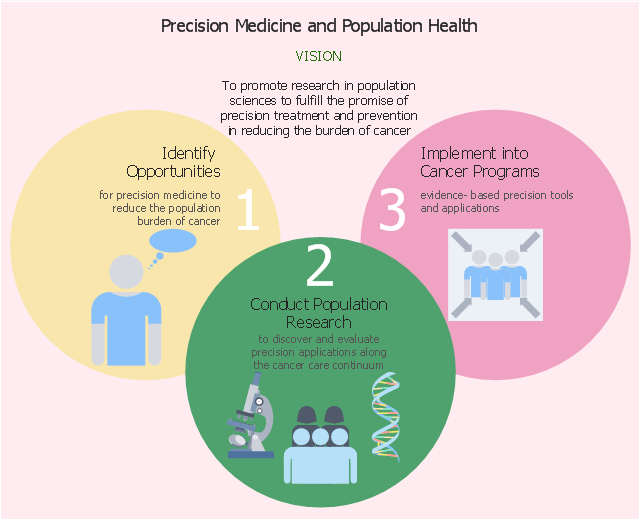
This biomedical infographic sample was designed on the base of the diagram on the webpage "Precision Medicine & Population Health" from the website of the Division of Cancer Control and Population Sciences (DCCPS) of the National Cancer Institute. [cancercontrol.cancer.gov/ research-emphasis/ precision-medicine.html]
"Precision medicine (PM) is a medical model that proposes the customization of healthcare, with medical decisions, treatments, practices, or products being tailored to the individual patient. In this model, diagnostic testing is often employed for selecting appropriate and optimal therapies based on the context of a patient’s genetic content or other molecular or cellular analysis. Tools employed in precision medicine can include molecular diagnostics, imaging, and analytics." [Precision medicine. Wikipedia]
"Population health ... is an approach to health that aims to improve the health of an entire human population. ... A priority considered important in achieving the aim of Population Health is to reduce health inequities or disparities among different population groups due to, among other factors, the social determinants of health, SDOH. The SDOH include all the factors (social, environmental, cultural and physical) that the different populations are born into, grow up and function with throughout their lifetimes which potentially have a measurable impact on the health of human populations. The Population Health concept represents a change in the focus from the individual-level, characteristic of most mainstream medicine." [Population health. Wikipedia]
The healthcare infographic example "Precision Medicine and Population Health" was designed using ConceptDraw PRO software extended with Biomedicine solution from Health area of ConceptDraw Solution Park.
"Precision medicine (PM) is a medical model that proposes the customization of healthcare, with medical decisions, treatments, practices, or products being tailored to the individual patient. In this model, diagnostic testing is often employed for selecting appropriate and optimal therapies based on the context of a patient’s genetic content or other molecular or cellular analysis. Tools employed in precision medicine can include molecular diagnostics, imaging, and analytics." [Precision medicine. Wikipedia]
"Population health ... is an approach to health that aims to improve the health of an entire human population. ... A priority considered important in achieving the aim of Population Health is to reduce health inequities or disparities among different population groups due to, among other factors, the social determinants of health, SDOH. The SDOH include all the factors (social, environmental, cultural and physical) that the different populations are born into, grow up and function with throughout their lifetimes which potentially have a measurable impact on the health of human populations. The Population Health concept represents a change in the focus from the individual-level, characteristic of most mainstream medicine." [Population health. Wikipedia]
The healthcare infographic example "Precision Medicine and Population Health" was designed using ConceptDraw PRO software extended with Biomedicine solution from Health area of ConceptDraw Solution Park.
Healthcare infographic
HelpDesk
How to Design Biomedical Drawings
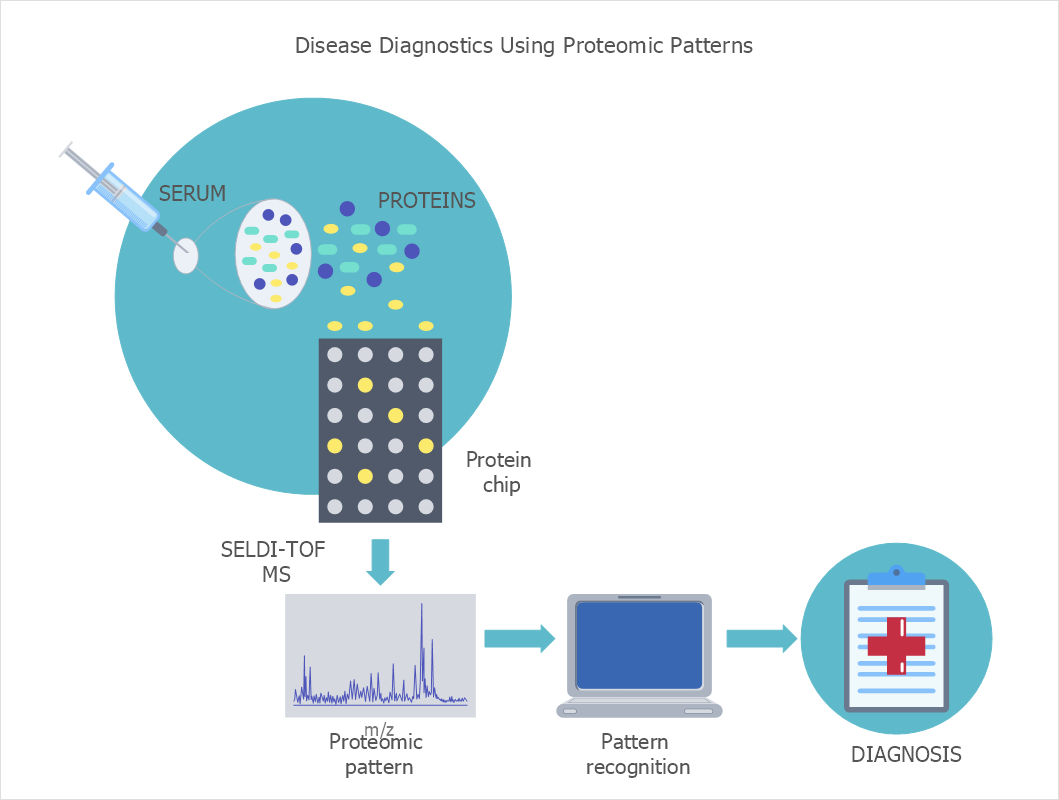
This medical diagram sample shows basic medical sciences.
"Medicine is the science and practice of the diagnosis, treatment, and prevention of disease. ... Contemporary medicine applies biomedical sciences, biomedical research, genetics, and medical technology to diagnose, treat, and prevent injury and disease, typically through pharmaceuticals or surgery, but also through therapies as diverse as psychotherapy, external splints and traction, medical devices, biologics, and ionizing radiation, amongst others. ...
In recent centuries, since the advent of modern science, most medicine has become a combination of art and science (both basic and applied, under the umbrella of medical science). While stitching technique for sutures is an art learned through practice, the knowledge of what happens at the cellular and molecular level in the tissues being stitched arises through science." [Medicine. Wikipedia]
The healthcare infographic example "Basic medical sciences" was designed using ConceptDraw PRO software extended with Health Sciences solution from Health area of ConceptDraw Solution Park.
"Medicine is the science and practice of the diagnosis, treatment, and prevention of disease. ... Contemporary medicine applies biomedical sciences, biomedical research, genetics, and medical technology to diagnose, treat, and prevent injury and disease, typically through pharmaceuticals or surgery, but also through therapies as diverse as psychotherapy, external splints and traction, medical devices, biologics, and ionizing radiation, amongst others. ...
In recent centuries, since the advent of modern science, most medicine has become a combination of art and science (both basic and applied, under the umbrella of medical science). While stitching technique for sutures is an art learned through practice, the knowledge of what happens at the cellular and molecular level in the tissues being stitched arises through science." [Medicine. Wikipedia]
The healthcare infographic example "Basic medical sciences" was designed using ConceptDraw PRO software extended with Health Sciences solution from Health area of ConceptDraw Solution Park.
Health sciences infographic
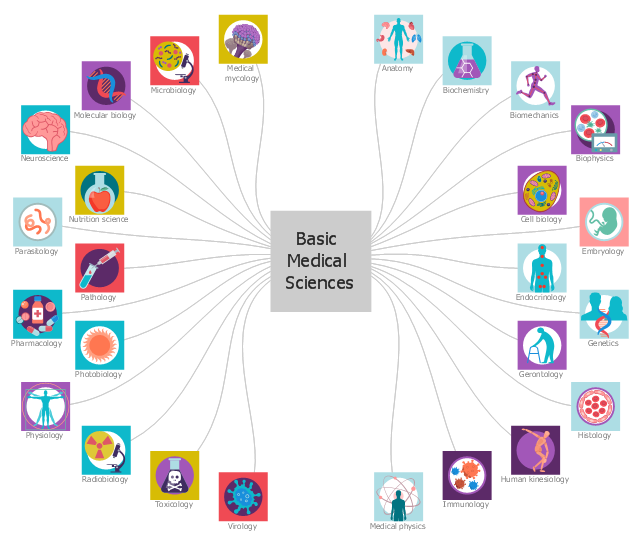
This biomedical infographic sample was designed on the base of figure 1 "Disease diagnostics using proteomic patterns" from the article "Cancer diagnosis using
proteomic patterns" by Thomas P. Conrads et al., Expert Rev. Mol. Diagn. 3(4), 411–420 (2003).
"The sample drawn from the patient is applied to a protein chip which is made up of a specific chromatographic surface. After several washing steps and the application of an energy-absorbing molecule, the species that are retained on the surface of the chip are analyzed via mass spectrometry. The pattern of peaks within the spectrum is an alyzed using sophisticated bioinformatic software to diagnose the source of the biological sample.
m/ z: Mass to charge ratio; SELDI-TOF MS: Surface-enhanced laser desorption/ ionization time-of-flight mass spectrometry." [home.ccr.cancer.gov/ ncifdaproteomics/ pdf/ ermd.pdf]
The healthcare infographic example "Disease Diagnostics Using Proteomic Patterns" was designed using ConceptDraw PRO software extended with Biomedicine solution from Health area of ConceptDraw Solution Park.
proteomic patterns" by Thomas P. Conrads et al., Expert Rev. Mol. Diagn. 3(4), 411–420 (2003).
"The sample drawn from the patient is applied to a protein chip which is made up of a specific chromatographic surface. After several washing steps and the application of an energy-absorbing molecule, the species that are retained on the surface of the chip are analyzed via mass spectrometry. The pattern of peaks within the spectrum is an alyzed using sophisticated bioinformatic software to diagnose the source of the biological sample.
m/ z: Mass to charge ratio; SELDI-TOF MS: Surface-enhanced laser desorption/ ionization time-of-flight mass spectrometry." [home.ccr.cancer.gov/ ncifdaproteomics/ pdf/ ermd.pdf]
The healthcare infographic example "Disease Diagnostics Using Proteomic Patterns" was designed using ConceptDraw PRO software extended with Biomedicine solution from Health area of ConceptDraw Solution Park.
Healthcare infographic

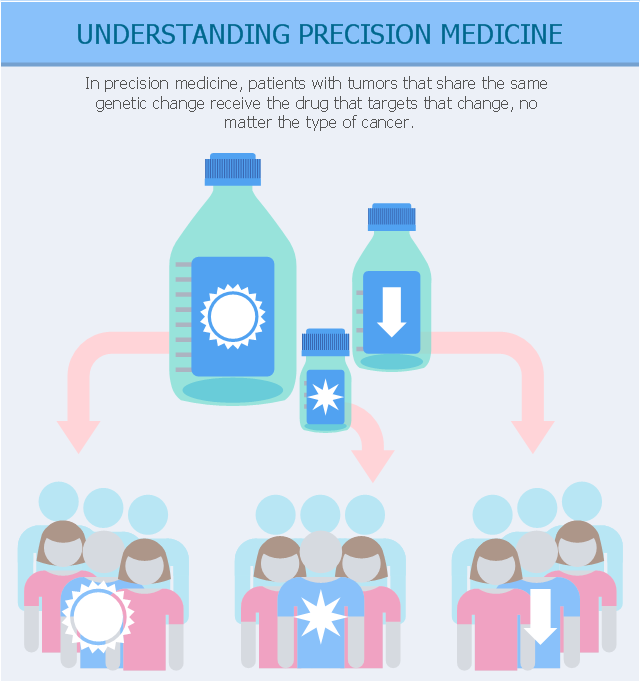
This biomedical infographic sample was designed on the base of the diagram on the webpage "Precision Medicine in Cancer Treatment" from the website of the National Cancer Institute, USA.
"Precision medicine is an approach to patient care that allows doctors to select treatments that are most likely to help patients based on a genetic understanding of their disease. This may also be called personalized medicine. The idea of precision medicine is not new, but recent advances in science and technology have helped speed up the pace of this area of research.
Today, when you are diagnosed with cancer, you usually receive the same treatment as others who have same type and stage of cancer. Even so, different people may respond differently, and, until recently, doctors didn’t know why. After decades of research, scientists now understand that patients’ tumors have genetic changes that cause cancer to grow and spread. They have also learned that the changes that occur in one person’s cancer may not occur in others who have the same type of cancer. And, the same cancer-causing changes may be found in different types of cancer." [cancer.gov/ about-cancer/ treatment/ types/ precision-medicine]
The healthcare infographic example "Understanding Precision Medicine" was designed using ConceptDraw PRO software extended with Biomedicine solution from Health area of ConceptDraw Solution Park.
"Precision medicine is an approach to patient care that allows doctors to select treatments that are most likely to help patients based on a genetic understanding of their disease. This may also be called personalized medicine. The idea of precision medicine is not new, but recent advances in science and technology have helped speed up the pace of this area of research.
Today, when you are diagnosed with cancer, you usually receive the same treatment as others who have same type and stage of cancer. Even so, different people may respond differently, and, until recently, doctors didn’t know why. After decades of research, scientists now understand that patients’ tumors have genetic changes that cause cancer to grow and spread. They have also learned that the changes that occur in one person’s cancer may not occur in others who have the same type of cancer. And, the same cancer-causing changes may be found in different types of cancer." [cancer.gov/ about-cancer/ treatment/ types/ precision-medicine]
The healthcare infographic example "Understanding Precision Medicine" was designed using ConceptDraw PRO software extended with Biomedicine solution from Health area of ConceptDraw Solution Park.
Healthcare infographic
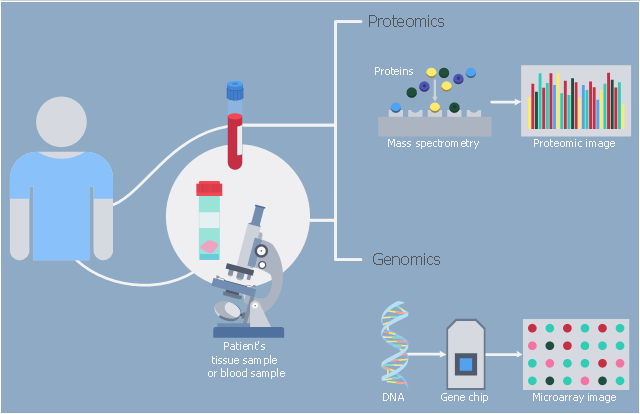
This biomedical infographic sample was designed on the base of Wikimedia Commons file: Molecular Diagnostics.jpg.
"Before molecular diagnostics, clinicians categorized cancer cells according to their pathology, that is, according to their appearance under a microscope.
Borrowing from two new disciplines, genomics (gee-no-micks) and proteomics (proh-tee-oh-mics), molecular diagnostics categorizes cancer using technology such as mass spectrometry and gene chips. Genomics is the study of all the genes in a cell or organism, while proteomics is the study of all the proteins. Molecular diagnostics determines how these genes and proteins are interacting in a cell. It focuses upon patterns--gene and protein activity patterns--in different types of cancerous or precancerous cells. Molecular diagnostics uncovers these sets of changes and captures this information as expression patterns. Also called "molecular signatures," these expression patterns are improving the clinicians' ability to diagnose cancer. Soon all cancers may be diagnosed this way." [commons.wikimedia.org/ wiki/ File:Molecular_ Diagnostics.jpg]
The healthcare infographic example "Molecular Diagnostics" was designed using ConceptDraw PRO software extended with Biomedicine solution from Health area of ConceptDraw Solution Park.
"Before molecular diagnostics, clinicians categorized cancer cells according to their pathology, that is, according to their appearance under a microscope.
Borrowing from two new disciplines, genomics (gee-no-micks) and proteomics (proh-tee-oh-mics), molecular diagnostics categorizes cancer using technology such as mass spectrometry and gene chips. Genomics is the study of all the genes in a cell or organism, while proteomics is the study of all the proteins. Molecular diagnostics determines how these genes and proteins are interacting in a cell. It focuses upon patterns--gene and protein activity patterns--in different types of cancerous or precancerous cells. Molecular diagnostics uncovers these sets of changes and captures this information as expression patterns. Also called "molecular signatures," these expression patterns are improving the clinicians' ability to diagnose cancer. Soon all cancers may be diagnosed this way." [commons.wikimedia.org/ wiki/ File:Molecular_ Diagnostics.jpg]
The healthcare infographic example "Molecular Diagnostics" was designed using ConceptDraw PRO software extended with Biomedicine solution from Health area of ConceptDraw Solution Park.
Healthcare infographic
- Biomedical sciences. Physics and bioengineering
- Health Sciences | How to Design Health Science Infographics ...
- Social determinants of health | Precision Medicine and Population ...
- How to Make Medical Illustrations | Internal Medicine | How to ...
- Medical Illustrations | Biomedicine | Best Diagramming Software for ...
- Biomedicine | Human Anatomy | Health Package | Where From I Get ...
- New Additions to Health Area in ConceptDraw Solutions
- Circle Diagrams | Health Sciences | Health Food | Health Circle ...
- Pdf Medical Shop Management Computer Language
- Process Flowchart | Fault Tree Analysis Diagrams | Flow chart ...


